
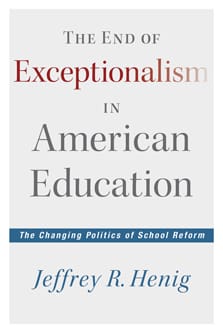
 Long viewed as the purview of local school boards and superintendents, education governance has become more complicated—and politicized—in recent years. Executives at every level, including mayors and governors, have gotten into the act. So have judges, legislators, and federal officials. In this book, Teachers College professor Jeff Henig makes sense of the complex and intersecting governance structures that we have today. He explains the “whys” of this shift: While school boards and superintendents (what he calls “single-purpose institutions”) were once widely viewed as apolitical experts, concerns about the country’s global competitiveness have called their expertise into question and opened school systems to criticism. He also speculates that newly active outside organizations (i.e., reform groups) find the more distant decision-makers (what Henig dubs “general purpose” bodies) more amenable to their interests and policy goals—and thus have advocated for their increased involvement in education. Henig also offers perspective on how the various actors engage with policy: Analyzing data on legislative activity, he finds that Congress and statehouses micromanage in all manners, while courts have become more active on such issues as racial segregation and school finance. Looking forward, Henig offers reasons for both concern and optimism. With so many cooks in the kitchen, there may be little hope for policy coherence. Still and all, he concludes that “general-purpose institutions” might be more able to give education clout in the broader policy conversation (it’s now not even a “top five” issue). Henig’s thesis comprises a chapter in our new book, Education Governance for the Twenty-First Century—and dovetails well with the other ideas therein.
SOURCE: Jeffrey R. Henig, The End of Exceptionalism in American Education: The Changing Politics of School Reform (Cambridge, MA: Harvard Education Press, 2013).
