Introductory economics teaches students to distinguish between complements and substitutes. Complements are interdependent goods: things like hot dogs and buns. Substitutes, on the other hand, are products that can replace each other, like coffee and tea.
In the education world, academics and career-technical training should be viewed as complements, not substitutes. That’s exactly how federal law describes career-and-technical education, which says that it “provides individuals with rigorous academic content and relevant technical knowledge and skills.” The “and” is pivotal. Career-tech—the serious kind that opens doors for young people—includes both strong academics and technical content. It’s not career-tech at the expense of academics.
Unfortunately, Ohio policy too often views career-tech and academics as substitutable. This is nowhere more evident than in graduation requirements. Recall that Ohio’s main graduation pathway requires students to demonstrate competency—a rather modest bar—on the state Algebra I and English II exams. So far so good, and most Ohio students do indeed achieve this standard. But here’s the catch: The state also allows students who are struggling to pass those tests to complete a career-technical alternative to graduate. To meet this option, students must attain industry credentials or pass technical course exams. The upshot: This loophole permits high schools to ignore students’ academic weaknesses and instead award diplomas based on career-technical measures alone.
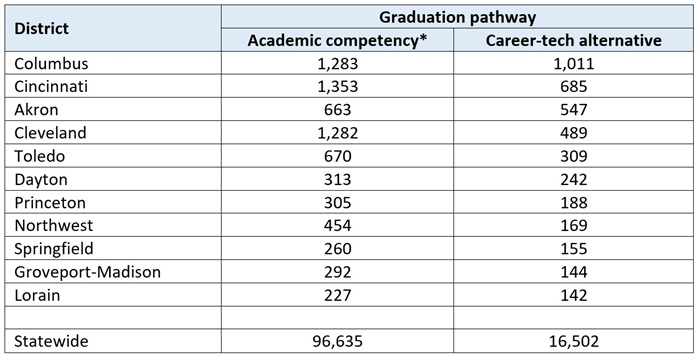
How often does this occur? Table 1 shows that 16,502 students in the class of 2024 received diplomas through the career-tech route (12 percent of the cohort). In districts such as Cincinnati, Cleveland, and Toledo, hundreds of students graduated this way. In Columbus and Akron, nearly as many students graduated via the career-tech option as met the state’s academic competency standard. Remember, such students did not demonstrate competency in English and math. Instead, as my recent report indicates, they often graduate by collecting credentials of questionable value, such as retail and public-safety certificates or generalist CPR certifications.
Table 1: Districts with the most students graduating via career-tech alternative
When schools award diplomas to students who cannot read, write, and do math, it sets them up for a lifetime of failure and frustration. Young people with a customer service certificate might be able to find an entry-level job in retail. But what if they want to move up the corporate ladder into a better paying position—one that might allow them to provide for a family? Or what if they want to start their own business? Those positions require strong English and math skills. Consider also how many professions—even those not necessarily demanding college degrees—require candidates to pass a standardized exam just to get their foot in the door. In the area of public safety, police officers, firefighters, and paramedics have to pass exams that require academic skill. Jobs in healthcare, construction, and financial services also have exams.
Poor academic preparation doesn’t just restrict entry to professions and limit job promotion, but it also hurts workers’ ability to change careers. Some workers—perhaps tired of the same routine or backbreaking work—may simply desire a change of scenery. Others might need to reskill due to larger economic forces, including the AI revolution that could easily decimate thousands of jobs. But their chances of a successful transition are diminished when they struggle to read basic materials or solve math problems.
Career-technical education, done right, can be a game changer for students. It gives them practical skills and experiences that ready them for the workforce. But it shouldn’t be a substitute for reading, writing, and arithmetic. Ohio must insist that every student is competent in English and math before graduation, while also providing greater flexibility in its course requirements to allow for rigorous technical training for those preparing for the workforce. Academics plus strong career-connected learning is the best way to ensure that the next generation of Ohioans have what they need for long-term success.