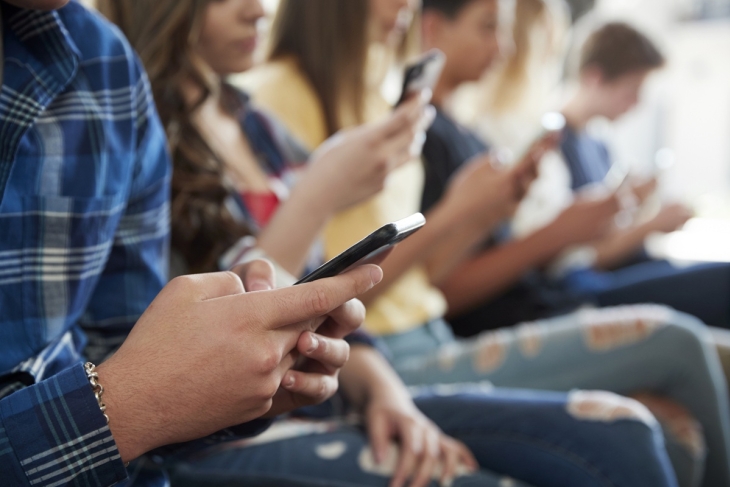
School systems across the country (and world) have been implementing limitations or outright bans on student smartphone use during the school day in an effort to improve the educational experience for young people. Improvements have been predicted along many dimensions: attention span, academic achievement, mental wellbeing, disciplinary referrals, and even absenteeism. But as ever, researchers are scrambling to catch up to this widespread and fast-moving policy development. A new report from the United Kingdom aims to provide some early data on the mental health impacts.
Researchers at the University of Birmingham in England launched a study in 2022 that uses a multi-method cross-sectional observational design. They will eventually evaluate the impact of school phone policies on a wide range of outcomes, including sleep, physical, activity, and educational achievement. But for now, the most recent report focuses on the important component of student mental wellbeing.
The research team compares students from a set of twenty English secondary schools (ages 12–15) that have restrictive smartphone policies and ten with permissive policies. In restrictive schools, phones were not allowed to be used during the school day for recreational purposes, and were required to be left at home or turned off and stored (personal bags, school lockers, electronically-sealed pouches, etc.) during the full school day. In permissive schools, phones were allowed to be used at any time or at certain times (such as lunch or class changes) and/or in certain areas (like hallways or outside the building).
The team recruited students in September 2022 and January 2023 from the various schools via flyers and emails. The final sample size was 817 students from restrictive schools and 406 students from permissive schools. The main outcome of interest was mental wellbeing, as assessed twice during the project using the Warwick-Edinburgh Mental Wellbeing Scales. This fourteen-item survey provides statements like “I’ve been feeling optimistic about the future” and “I’ve been feeling close to other people” and asks for a response on a five-point scale from “none of the time” to “all of the time.” Secondary data captured included smartphone and social media usage, as recorded by an app on student phones and as reported on student surveys. The researchers used mixed effects linear regression models to explore associations between school phone policy and participant outcomes, and between phone and social media use time and participant outcomes.
As expected, students attending schools with restrictive smartphone policies recorded lower phone and social media time use during the school day. Average phone use approached one hour for permissive schools, but just short of eleven minutes for restrictive schools. Average social media use was nearly eradicated during the school day in restrictive schools (under two minutes) compared to half an hour in permissive schools. However, there was no statistically significant difference in overall use of smartphones and social media between the groups of students during weekdays—implying that students in restrictive schools “made up time” on their devices before or after school—or on weekend days. The typical student in both groups used their phones for approximately 1.7 hours per day on a weekday and approximately 2 hours per day on weekend days.
Similarly, mental wellbeing scores were nearly identical among students in both groups. The mean overall was 47 on a scale of 0 to 70 (highest score), indicating a “medium level” of wellbeing according to the survey instrument. The mean for students in permissive schools was 48; restrictive schools, 46. And there was no evidence of a difference between groups when the researchers controlled for variables such as gender, income, and student achievement levels. However, increases in both smartphone use and social media time were associated with increases in anxiety and depression scores (that is, specific subsets of questions) on the wellbeing survey.
These data indicate that more device usage time does lead to more anxiety and depression for young people, as many pundits and policymakers suspect. But they also indicate that smartphone restrictions in schools do not impact mental wellbeing in students. Schools that restrict phone usage when students are on campus are doing their part to combat the problem, but that is not enough in itself to see a positive impact. The authors suggest that such school-based policies require further development if they are to ever successfully address that goal, but it seems likely that a more ambitious effort is required to successfully curtail phone and social media usage to the levels needed.
SOURCE: Victoria A. Goodyear et al., “School phone policies and their association with mental wellbeing, phone use, and social media use (SMART Schools): a cross-sectional observational study,” Lancet Regional Health Europe (February 2025).