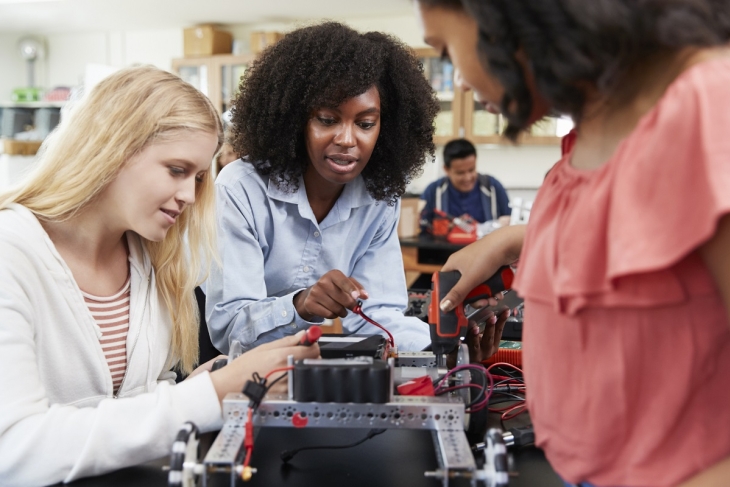
In response to technological innovations and a rapidly changing economy, schools across the nation have increasingly focused on offering curricula and programs centered around the principles of STEM—science, technology, engineering, and mathematics.
While other educational fads have faded, STEM has endured. In December 2018, the federal government released a report on its five-year strategy for increasing access to high quality STEM education. The ACT publishes reports on the condition of STEM nationally and in each state, and it highlighted STEM results in its 2018 report on the condition of college and career readiness. There are no shortage of blog posts and articles about why STEM education is so important.
Ohio is no exception. The Buckeye State has a unique relationship with STEM thanks to state law and a partnership between the Ohio Department of Education (ODE), the Ohio STEM Learning Network, and the Ohio STEM committee. There are nearly seventy schools that have applied for and received Ohio’s STEM and STEAM (which adds an A for arts education) designation. They include traditional district, charter, and private schools that teach a STE(A)M curriculum, focus on “real-world, project-based experiences,” and have well-established partnerships with businesses, nonprofits, and institutions of higher education.
Chances are that most Ohioans are familiar with at least one STEM-designated school; LeBron’s I Promise School in Akron is one. But what most people don’t know is that Ohio is also home to several independent STEM schools—public schools that are not governed or operated by a traditional district and differ from charter schools because of their governing body, academic offerings, or mission. These schools are completely and entirely focused on integrating STEM education into every subject and content area. STEM isn’t just part of who they are, it is who they are.
On its most recent list of STEM designated schools, ODE identifies seven independent STEM schools:
|
School name |
City |
County |
Grades |
Enrollment |
|
|
Rootstown |
Portage |
7–12 |
607 |
|
|
Dayton |
Montgomery |
9–12 |
652 |
|
|
Springfield |
Clark |
7–12 |
640 |
|
iSTEM Geauga Early College High School
|
Concord Township |
Lake |
9–12 |
178 |
|
Metro Early College High School
|
Columbus |
Franklin |
6–12 |
926 |
|
Tri-State STEM-M Collaboration
|
South Point |
Lawrence |
9–12 |
66 |
|
|
Youngstown |
Mahoning |
9–12 |
201 |
As indicated in the chart above, all of these schools serve middle and high school students. They are geographically diverse; four out of the five regions in Ohio contain at least one independent STEM school. Metro is the largest school, with an enrollment of 926, and Tri-State is the smallest with only sixty-six students. According to the most recently released state report cards, the demographics of each school are pretty similar. They all have a majority white student population with the exception of Metro, where just over 59 percent of its student body is non-white. Only three schools reported an economically disadvantaged population larger than 25 percent: Global Impact (26.3 percent), Metro (34.9 percent), and Valley STEM-ME2 (57.1 percent).
When it comes to student performance, the schools produce varied results. Here’s a look at how each school performed on the major components of the recent state report card.
|
School |
Overall grade |
Achievement |
Progress |
Gap Closing |
Prepared for Success |
|
Bio-Med Science Academy |
B |
C |
F |
A |
A |
|
Dayton Regional STEM School |
B |
B |
D |
A |
B |
|
Global Impact STEM Academy |
D |
D |
D |
D |
D |
|
iSTEM Geauga Early College High School |
A |
B |
A |
A |
Not Rated* |
|
Metro Early College High School |
B |
C |
B |
A |
C |
|
Tri-State STEM-M Collaborative |
D |
C |
F |
F |
Not Rated* |
|
Valley STEM+ME2 Academy |
D |
D |
D |
F |
Not Rated* |
*Schools were not assigned a Prepared for Success rating if they did not have enough students in the graduating class of 2018 to evaluate.
As you can see, the data are pretty evenly split between high and low performance. Four schools earned an overall grade of A or B, while three schools received an overall D. Two of the schools that earned overall Ds opened relatively recently—Tri-State STEM-M opened in 2017, and Valley STEM+ME2 Academy opened in 2016—which may explain why their overall grades are lower than that of their more veteran peers, who have had longer to implement the wholesale changes called for in being entirely STEM focused.
None of the schools earned an A on the achievement component, though the majority earned at least a C. It’s worth noting that, as alternatives to traditional district schools, independent STEM schools attract students who are dissatisfied with their zoned school or have been poorly served, and may have fallen behind their peers as a result. Consequently, results on the progress component—which tracks whether all students, including those below grade level, make growth during the year—become even more important. Unfortunately, the progress results are a bit gloomy: iSTEM earned an A, and Metro earned a B, but the remaining schools earned either a D or an F. These low grades indicate that students aren’t learning as much as expected. Most schools fared much better on Gap Closing, though, which shows how well schools meet performance expectations for vulnerable populations of students. The results for schools that were rated in Prepared for Success are also largely positive.
Overall, it appears that Ohio’s independent STEM schools are a microcosm of the state’s larger education sector: Some schools are knocking it out of the park, while others have a bit more work to do before they can be labeled high performing. Like other schools of choice, STEM schools are increasingly in demand. As they expand—and perhaps as additional schools open—the independent STEM model will become more widely known. In the meantime, one thing’s for sure: These schools are a vital part of Ohio’s bevy of school choice options.