Mobile Navigation

  • National
    • Policy
      • High Expectations
      • Quality Choices
      • Personalized Pathways
    • Research
    • Commentary
      • Gadfly Newsletter
      • Flypaper Blog
    • Events
    • Scholars Program
  • Ohio
    • Policy
      • Priorities
      • Media & Testimony
    • Research
    • Commentary
      • Ohio Education Gadfly Biweekly
      • Ohio Gadfly Daily
  • Charter Authorizing
    • Application
    • Sponsored Schools
    • Resources
  • About
    • Mission
    • Board
    • Staff
    • Career
Home
Home
Advancing Educational Excellence

Main Navigation

  • National
  • Ohio
  • Charter Authorizing
  • About

Ohio Menu

  • Topics
    • Accountability & Testing
    • Advanced Education
    • Career & Technical Education
    • Charter Schools
    • Curriculum & Instruction
    • ESSA
    • Evidence-Based Learning
    • Governance
    • Personalized Learning
    • Private School Choice
    • School Finance
    • Standards
    • Teachers & School Leaders
  • Research
  • Policy
  • Commentary
    • Ohio Gadfly Newsletter
    • Ohio Gadfly Blog
    • Events

The Education Gadfly Weekly

Sign Up to Receive Fordham Updates

We'll send you quality research, commentary, analysis, and news on the education issues you care about.
Thank you for signing up!
Please check your email to confirm the subscription.

The Ohio Education Gadfly: Mayor Jackson’s reasonable request of Ohio’s charter community

Volume 6, Number 10
5.8.2012
5.8.2012

The Ohio Education Gadfly: Mayor Jackson’s reasonable request of Ohio’s charter community

Volume 6, Number 10
view

Smarter Budgets, Smarter Schools: How to Survive and Thrive in Tight Times

For school administrators and board members lost in the forest of books, reports, and briefs written on “doing more with less,” this outstanding volume provides a compass, map, and sturdy walking stick.

Chris Tessone 5.8.2012
OhioBlog

Smarter Budgets, Smarter Schools: How to Survive and Thrive in Tight Times

Chris Tessone
5.8.2012
Blog

Reclaiming The American Dream: Community Colleges And The Nation’s Future

Hanif Abdurraqib
5.8.2012
Blog

How Blogs, Social Media, and Video Games Improve Education

Adrienne King
5.8.2012
Blog

Ohio’s elementary special ed students see improvement while their high school peers languish

Aaron Churchill
5.8.2012
Blog

Early reports from the heartland show support for the Common Core

Terry Ryan
5.8.2012
Blog

Smarter Budgets, Smarter Schools: How to Survive and Thrive in Tight Times

Chris Tessone
5.8.2012
Blog

How Blogs, Social Media, and Video Games Improve Education

Adrienne King
5.8.2012
Blog

Reclaiming The American Dream: Community Colleges And The Nation’s Future

Hanif Abdurraqib
5.8.2012
Blog
view

Reclaiming The American Dream: Community Colleges And The Nation’s Future

Hanif Abdurraqib 5.8.2012
Blog
view

How Blogs, Social Media, and Video Games Improve Education

Adrienne King 5.8.2012
Blog
view

Ohio’s elementary special ed students see improvement while their high school peers languish

Aaron Churchill 5.8.2012
Blog
view

Early reports from the heartland show support for the Common Core

Terry Ryan 5.8.2012
Blog
view

Smarter Budgets, Smarter Schools: How to Survive and Thrive in Tight Times

Chris Tessone 5.8.2012
Blog
view

How Blogs, Social Media, and Video Games Improve Education

Adrienne King 5.8.2012
Blog
view

Reclaiming The American Dream: Community Colleges And The Nation’s Future

Hanif Abdurraqib 5.8.2012
Blog
view

Smarter Budgets, Smarter Schools: How to Survive and Thrive in Tight Times

Chris Tessone
5.8.2012
Blog

For school administrators and board members lost in the forest of books, reports, and briefs written on “doing more with less,” this outstanding volume provides a compass, map, and sturdy walking stick.

Finance guru (and former superintendent of Arlington [MA] Public Schools) Nathan Levenson offers rational, honest, and tangible ways for cash-strapped district leaders to shed budget heft without compromising student learning. Guided by four principles—embrace “crazy” ideas, analyze details to make informed decisions, spend on what works, and align interests—Levenson explains how to manage even the most sacrosanct of education-budget items (all without the need for legislative changes or union approval).

For example, district leaders should base funding on academic return on investment (A-ROI) determinations—cutting ineffective programs and beefing up those that see results. Take early investment in reading: In an average-sized elementary school (about 400 students), early reading intervention costs about $2,500 per child (and takes about three years to get struggling students up to grade level). Compare this with special-education referral and placement—which costs an additional $5,000 per year (for mild to moderately disabled students) and likely will last throughout the student’s K-12 career.

This need to look beyond singular budget line-items manifests in staffing costs as well. Superintendents must think about fully loaded costs (salary plus benefits) when planning for personnel shifts—and must be willing to think creatively about how to fill certain positions. Levenson provides an anecdote: To save the district long-term dollars, he reclassified a part-time clerical office position as “paraprofessional” (meaning that it didn’t qualify for benefits packages or fit union rules for automatic salary step increases). The first fully loaded cost totaled about $80,000 for the position instead of $350,000 in the old system.

Along with these insightful and concrete examples, Levenson provides sample budgets, staffing formulae, and worksheets—all geared toward helping readers find specific solutions to their individual districts’ budget woes. (The book also has a linked online tool that further simplifies this process for district admins.) It blazes a clear trail to leaner and more productive district spending—prepare to take notes.

view

Reclaiming The American Dream: Community Colleges And The Nation’s Future

Hanif Abdurraqib
5.8.2012
Blog

In this report, the American Association of Community Colleges (AACC) examines the “21st-Century Initiative, the overall goal of which is to arm an additional five million students with diplomas, certificates, or other credentials by 2020.

Reclaiming the American Dream outlines the shortcomings of community colleges in student success rates, job preparation, and aiding high school students in a transition to the college lifestyle. For example, only 46 percent of students who enter community college focused on earning a credential attain that goal, transfer to a four-year institution, or are still enrolled six years later. The rates are even lower among minority and low-income students.

AACC lays out policy ideas for improving the system: require students to participate in on-campus orientation, insist on first-semester advisement for a structured program of study, embed developmental education instruction into credit-bearing courses, and call on four-year institutions to agree upon courses that will transfer without loss of credits. The goal is to have community colleges serve as more than pit stops, and instead to be real options for learning a trade and developing job skills that are relevant in the ever-changing economy.

Fortunately for Buckeye State students, these recommendations are largely already in place – or the state and its schools are actively working toward enacting them. This report was partially funded by Cuyahoga Community College, which will work with the association to develop a strategic plan to help that school improve its students’ outcomes.

view

How Blogs, Social Media, and Video Games Improve Education

Adrienne King
5.8.2012
Blog

The mass implementation of communication technology delivery tools like blogs, wikis, and Twitter has radically changed how information is disseminated and received. Now, for better or worse, anyone interested in a topic can contribute to a conversation, rather than rely solely on “experts” in a given field. The report “How Blogs, Social Media, and Video Games Improve Education,” by The Brookings Institute, discusses the varying uses and influences of new media on education.

Blogs allow anyone interested in a topic to partake in the discussion. Nielson – the marketing research company -- estimates there are over 156 million blogs on the Internet, with 5,000 blogs in the United States dedicated to education topics alone. Topics range from school finance to instructional technology to pedagogical technique. School officials use blogs to disseminate information to parents and the public, addressing specific problems and how they should be handled. Blogs encourage reflection, critical thinking, enhanced writing skills, and collaboration as long as teachers clearly set guidelines and explain rationale for pedagogic activity.

Wikis are websites that allow multiple users to edit the content. They utilize crowd-sourcing collaboration, meaning a group filter allows collective judgment to determine the best wisdom. Teachers have used wikis to teach poetry, and find them especially useful for distance learning or classes where group work requires applied practice experiences. They also allow student input on reading materials throughout the semester or school year.

Social media and mobile devices offer convenience in the classroom. Students can take handheld devices into the field to gather data or test hypotheses. While social networking sites like Facebook, Google+, and others offer personal recommendations from friends, most primary and secondary schools do not allow social media or mobile devices in school. At some universities, however, professors use Twitter to pose questions prior to class: Research finds there is 87 percent mastery on Tweeted question versus 43 percent mastery of non-Tweeted questions.

Teachers use video games to teach basic concepts and solve practical problems. The report cites The National Research Council which says that video games “enable learners to see and interact with representations of natural phenomena that would otherwise be impossible to observe.” Video games also have built-in feedback that helps teachers identify a student’s weakness without the daunting “wrong answer” paper and pen tests; instead, the student just keeps playing until the player solves the problem at hand.

eTech Ohio has many different programs for bringing technology into the classroom. Through funding from the American Recovery and Reinvestment Act (ARRA), eTech is encouraging school districts across Ohio to invest in 21st century learning and professional development. This push is especially timely as Ohio is transitioning to online assessments in 2014-15.


view

Ohio’s elementary special ed students see improvement while their high school peers languish

Aaron Churchill
5.8.2012
Blog

"For too long we've been a compliance-driven bureaucracy when it comes to educating students with disabilities. We have to expect the very best from our students—and tell the truth about student performance—so that we can give all students the supports and services they need." – U.S. Secretary of Education Arne Duncan, March 12, 2012

We agree, Mr. Secretary. Here in Ohio, we’ve seen special education costs skyrocket over the last decade; increasing over $1 billion dollars, a 50 percent jump. In contrast, non-special-education spending increased only 17 percent during the same period. Today, special education eats nearly 20 percent of Ohio’s entire K-12 education spending pie, up five percentage points from a decade ago.

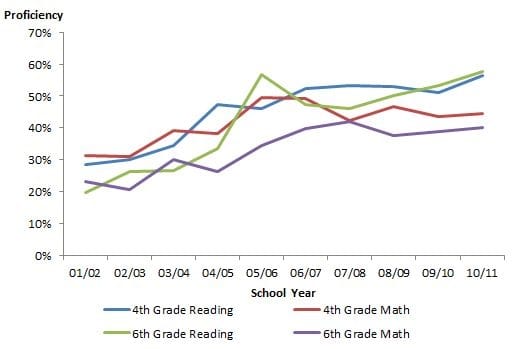
Are Ohio’s special education students benefiting from all this spending? Not if you look at their student achievement. Consider, the test performance data for fourth- and sixth-grade students with specific learning disabilities (the largest subgroup of special ed students):

Figure 1: Improving test scores for primary school, learning-disabled students (2001-02 to 2010-11)
Source: Ohio Department of Education

Clearly, on the up and up.

But consider now the tenth-grade performance of students with learning disabilities:

Figure 2: Declining test scores for secondary school, learning-disabled students (2001-02 to 2010-11)

Source: Ohio Department of Education

Not so great.

The rise in Ohio’s special education spending seems to have improved primary school SPED performance. Yet the declining high school data pose a sticky distributional question about special education spending: Are we overspending in primary grades, while ignoring high school students’ needs? If that’s the case, we’re effectively losing primary school gains, while also burning through the special education budget—an increasingly large piece of the overall education budget.

As Secretary Duncan suggests, the truth about special education should be told. And in Ohio, the truth seems to be this: Special education is driving up overall education spending and there is an apparent disparity between SPED at the primary and secondary levels. It’s time to seriously take stock of special education and ask if it can be done smarter and better.

view

Early reports from the heartland show support for the Common Core

Terry Ryan
5.8.2012
Blog

Fordham has commissioned the former editorial page editor of the Dayton Daily News, Ellen Belcher, to interview educators from across Ohio to learn about their hopes and concerns per early efforts to implement the Common Core in their districts and schools.

The report, Future Shock: Early Common Core Lessons from Ohio Implementers, will be released next week, but some of Belcher’s findings are worth reporting early because this is such a burning issue for schools and educators across the state. Here is a quick sample of some of what Belcher discovered in speaking with real educators working in real schools to implement the Common Core in the Buckeye State:

  • Educators see the “big picture,” the “global” problems that the Common Core aims to address ( i.e. U.S. students’ lackluster performance among their international competitors and the large number of high-school graduates who are not prepared for college or a career).
  • A common language around the Common Core is being widely used. The educators spoke of
  • “rigor and relevance,” “formative assessments,” “short cycle assessments,” “formative instructional practices,” “professional learning communities,” “curriculum-based assessments,” “curriculum alignment,” “curriculum maps,” “project-based learning,” “portfolio-based assessments,” “higher level thinking,” “performance-based testing” and “critical thinking skills.”
  • Teachers want and appreciate tools they can “see.” What does “rigor and relevance” look like? (Good curriculum models are “very calming…in a sea of turbulence” shared one Cincinnati educator.)
  • Everyone understands that data are king. Interviewees believe data are the secret to identifying and eliminating achievement gaps at the district level, the classroom level, and the student level.
  • Emotions are high and run the gamut. Teachers are excited that they are being asked to ‘go deep’ and that standards are being raises. At the same time, there is fear about whether the new summative assessments will get it right, whether the tests really will be good measures of what students have learned.
  • Collaboration has become standard operating procedure among schools, among districts, and with other entities such as the Council of Great City Schools, Battelle for Kids, the Gates Foundation, the General Electric Foundation, the Ohio Alliance for Public Charter Schools, the Ohio Appalachian Collaborative, the American Federation of Teachers and local educational service centers. No one feels like they’re working in a vacuum – or thinks that would be smart.

The educators in Ohio interviewed by Belcher, the people on the frontlines of our schools who work daily with our kids, see the move toward the Common Core as a positive. But, they worry seriously about the implementation challenges, and they fear that somehow our political leadership class will screw all of this up and turn a good into something bad. Or, as one Cleveland educator remarked, “the Common Core is the right work we should be doing as a country.” “But let’s not make this the metric system of our time… and all of sudden stop.” This is thoughtful guidance from someone actually doing the work.

Visit www.edexcellence.net next Friday, May 18, to download Future Shock: Early Common Core Lessons from Ohio Implementers.

view

Smarter Budgets, Smarter Schools: How to Survive and Thrive in Tight Times

Chris Tessone
5.8.2012
Blog

For school administrators and board members lost in the forest of books, reports, and briefs written on “doing more with less,” this outstanding volume provides a compass, map, and sturdy walking stick.

Finance guru (and former superintendent of Arlington [MA] Public Schools) Nathan Levenson offers rational, honest, and tangible ways for cash-strapped district leaders to shed budget heft without compromising student learning. Guided by four principles—embrace “crazy” ideas, analyze details to make informed decisions, spend on what works, and align interests—Levenson explains how to manage even the most sacrosanct of education-budget items (all without the need for legislative changes or union approval).

For example, district leaders should base funding on academic return on investment (A-ROI) determinations—cutting ineffective programs and beefing up those that see results. Take early investment in reading: In an average-sized elementary school (about 400 students), early reading intervention costs about $2,500 per child (and takes about three years to get struggling students up to grade level). Compare this with special-education referral and placement—which costs an additional $5,000 per year (for mild to moderately disabled students) and likely will last throughout the student’s K-12 career.

This need to look beyond singular budget line-items manifests in staffing costs as well. Superintendents must think about fully loaded costs (salary plus benefits) when planning for personnel shifts—and must be willing to think creatively about how to fill certain positions. Levenson provides an anecdote: To save the district long-term dollars, he reclassified a part-time clerical office position as “paraprofessional” (meaning that it didn’t qualify for benefits packages or fit union rules for automatic salary step increases). The first fully loaded cost totaled about $80,000 for the position instead of $350,000 in the old system.

Along with these insightful and concrete examples, Levenson provides sample budgets, staffing formulae, and worksheets—all geared toward helping readers find specific solutions to their individual districts’ budget woes. (The book also has a linked online tool that further simplifies this process for district admins.) It blazes a clear trail to leaner and more productive district spending—prepare to take notes.

view

How Blogs, Social Media, and Video Games Improve Education

Adrienne King
5.8.2012
Blog

The mass implementation of communication technology delivery tools like blogs, wikis, and Twitter has radically changed how information is disseminated and received. Now, for better or worse, anyone interested in a topic can contribute to a conversation, rather than rely solely on “experts” in a given field. The report “How Blogs, Social Media, and Video Games Improve Education,” by The Brookings Institute, discusses the varying uses and influences of new media on education.

Blogs allow anyone interested in a topic to partake in the discussion. Nielson – the marketing research company -- estimates there are over 156 million blogs on the Internet, with 5,000 blogs in the United States dedicated to education topics alone. Topics range from school finance to instructional technology to pedagogical technique. School officials use blogs to disseminate information to parents and the public, addressing specific problems and how they should be handled. Blogs encourage reflection, critical thinking, enhanced writing skills, and collaboration as long as teachers clearly set guidelines and explain rationale for pedagogic activity.

Wikis are websites that allow multiple users to edit the content. They utilize crowd-sourcing collaboration, meaning a group filter allows collective judgment to determine the best wisdom. Teachers have used wikis to teach poetry, and find them especially useful for distance learning or classes where group work requires applied practice experiences. They also allow student input on reading materials throughout the semester or school year.

Social media and mobile devices offer convenience in the classroom. Students can take handheld devices into the field to gather data or test hypotheses. While social networking sites like Facebook, Google+, and others offer personal recommendations from friends, most primary and secondary schools do not allow social media or mobile devices in school. At some universities, however, professors use Twitter to pose questions prior to class: Research finds there is 87 percent mastery on Tweeted question versus 43 percent mastery of non-Tweeted questions.

Teachers use video games to teach basic concepts and solve practical problems. The report cites The National Research Council which says that video games “enable learners to see and interact with representations of natural phenomena that would otherwise be impossible to observe.” Video games also have built-in feedback that helps teachers identify a student’s weakness without the daunting “wrong answer” paper and pen tests; instead, the student just keeps playing until the player solves the problem at hand.

eTech Ohio has many different programs for bringing technology into the classroom. Through funding from the American Recovery and Reinvestment Act (ARRA), eTech is encouraging school districts across Ohio to invest in 21st century learning and professional development. This push is especially timely as Ohio is transitioning to online assessments in 2014-15.


view

Reclaiming The American Dream: Community Colleges And The Nation’s Future

Hanif Abdurraqib
5.8.2012
Blog

In this report, the American Association of Community Colleges (AACC) examines the “21st-Century Initiative, the overall goal of which is to arm an additional five million students with diplomas, certificates, or other credentials by 2020.

Reclaiming the American Dream outlines the shortcomings of community colleges in student success rates, job preparation, and aiding high school students in a transition to the college lifestyle. For example, only 46 percent of students who enter community college focused on earning a credential attain that goal, transfer to a four-year institution, or are still enrolled six years later. The rates are even lower among minority and low-income students.

AACC lays out policy ideas for improving the system: require students to participate in on-campus orientation, insist on first-semester advisement for a structured program of study, embed developmental education instruction into credit-bearing courses, and call on four-year institutions to agree upon courses that will transfer without loss of credits. The goal is to have community colleges serve as more than pit stops, and instead to be real options for learning a trade and developing job skills that are relevant in the ever-changing economy.

Fortunately for Buckeye State students, these recommendations are largely already in place – or the state and its schools are actively working toward enacting them. This report was partially funded by Cuyahoga Community College, which will work with the association to develop a strategic plan to help that school improve its students’ outcomes.

Fordham Logo

© 2026 The Thomas B. Fordham Institute
Privacy Policy
Usage Agreement

National

P.O. Box 110
Burke, VA 22009

202.223.5452

[email protected]

Ohio

P.O. Box 82291
Columbus, OH 43202

614.223.1580

[email protected]

Sponsorship

130 West Second Street, Suite 410
Dayton, Ohio 45402

937.227.3368

[email protected]