
The Nation’s Report Card: Science 2011
Good news and bad news for the Buckeye State
Good news and bad news for the Buckeye State
Good news and bad news for the Buckeye State. The bad news first: in the recently-released “The Nation’s Report Card” for eighth grade science scores, Ohio fell eight spots in the state rankings. The good news: despite the drop, Ohio continued to outperform the national average in science scores.
Issued by the U.S. Department of Education, the Report Card publishes National Assessment of Educational Progress (NAEP) results and provides inter-state and year-to-year comparisons of student performance. Nationally, the results were encouraging as scores trended upwards and achievement gaps narrowed. (My colleague Daniela Fairchild reviews the national data here.)
Ohio’s 2011 average science test score remained flat compared to 2009, causing the Buckeye State to fall behind states whose test scores improved. However, Ohio still bests the national test average by seven points, and its average test scores also remain near the top among the states—fifteenth out of fifty. Additionally, Ohio continues to outperform the national percentage of students scoring “above proficient” and “above basic.”
These science scores are critical, for they predict our nation’s ability to meet the demands of the future marketplace. Ohio’s future, therefore, rests on how well it equips today’s kids with the scientific tools for tomorrow’s needs. Ohio’s mixed NAEP results—still a national leader in science scores but with a flat-line performance trend—should motivate the Buckeye State to continue its aggressive investment in kids’ science education. By investing in science, Ohio can plant the seeds for its economic future, today.
The Nation’s Report Card: Science 2011
U.S. Department of Education, Institute of Education Sciences
May 2012
The New Teacher Project's (TNTP) Greenhouse Schools considers the link between a school’s instructional culture and both teacher retention and student achievement. TNTP surveyed 4,800 teachers in 250 schools nationwide (including charter schools) to determine what it calls “greenhouse schools”, or schools that nurture a great learning environment. These schools prioritize quality educators above all else, in attempts to foster the best learning environment possible. TNTP found that “greenhouse schools” keep more top teachers and get better results for students compared to schools with weaker instructional culture. The report then looks at what those schools are doing differently.
Based on its study, TNTP suggests that these are the principles for improving schools, using strong instructional culture as a foundation:
Principals and school leaders need to examine ways to improve their instructional culture, and then proceed to implement a plan to set these goals in motion.
Greenhouse Schools: How Schools Can Build Cultures Where Teachers and Students Thrive
The New Teacher Project
April, 2012
In fall 2011, U.S. Secretary of Education Arne Duncan announced the administration’s decision to allow states to apply for waivers to the federal No Child Left Behind Act (NCLB) requirements. To receive consideration for these waivers states had to establish “college and career- ready” expectations, develop and implement differentiated accountability systems, and develop teacher and principal evaluations systems. The U.S. Department of Education granted waivers to eleven states during the first-round application process. Another 27 states currently have an application under consideration in the second round.
A recent report by the Center on Education Policy (CEP) takes a look at the major accountability themes proposed by the 27 states in the second round, focusing on common themes among these states.
CEP found that the waiver applications in general are more complex than the current provisions of NCLB. The following are among the major accountability themes detected in the applications:
Ohio was one of the 27 states that applied for a waiver during the second-round application process. As the CEP report suggests, Ohio’s application follows many of the major themes mentioned above. Ohio adopted the Common Core in 2010 and if its application is approved it would represent a major shift in the way schools and districts are graded, as well as dismantle the current tutoring program. Ohio’s application, like the other 26 states, represents a major shift in the current policies prescribed in NCLB.
Major Accountability Themes of Second-Round State Applications for NCLB Waivers
Center on Education Policy
May 2012
A report released by the Stanford Center for Opportunity Policy in Education advances the discussion about quality teacher evaluations and professional development within the greater context of a continuous learning system. Creating a Comprehensive System for Evaluating and Supporting Effective Teaching by Linda Darling-Hammond, argues for a high-quality teaching and student learning system that doesn’t simply focus on arbitrary value-added measures; rather, it follows these three objectives: (1) Supports all stages of teaching, (2) Relates seamlessly what teachers do in the classroom and how they are prepared and assessed, and (3) Develops teaching contexts that facilitate good practice in addition to identifying and rewarding effective teachers.
There are seven criteria necessary to achieve these goals:
These seven criteria create a cyclical system based on constant support and development. The feedback loop develops the best standards and teaching practices, supports administrators to be trained in observation and feedback, and supports professional development opportunities to help teachers explore new teaching practices. This constantly-churning system of communication and feedback can develop the best standards and teaching practices.
Although the Buckeye State has started down the path to quality teacher evaluations, there is still much work to be done. This report suggests a construct for high-quality teaching evaluation and professional development—and professional development matters: Less than 14 hours of teacher professional development a year on a topic had no effect on student learning. Yet, high-quality programs with 50 hours over a 6 to 12 month period increased student achievement by 21 percentage points on average.
Creating a Comprehensive System for Evaluating and Supporting Effective Teaching
Stanford Center for Opportunity Policy in Education
Linda Darling-Hammond
2012

The era of the chalkboard is over. Laptops, SMART boards, Wikis, YouTube, and Gaming are in. Is this progress or just distraction? That was the topic of conversation among nearly 300 educators and policymakers at Fordham’s “Digital Learning: The Future of Schooling?” event last week. (Please check out the video replay here.)
Ohio State Superintendent Stan Heffner opened the event by laying out the problematic mix of technology, education, and kids: “Kids spend their nights in high-tech bedrooms and spend their days in low-tech classrooms.” The remainder of the conversation focused on how to harness kids’ aptitude in technology for effective educational practices.
Fordham – and our event partners, KnowledgeWorks and the Nord Family Foundation –assembled an elite group of digital learning experts and Ohio practitioners to explore best practices and policies. The event’s first panel consisted of four national experts (U.S. Department of Education’s Karen Cator, Public Impact’s Bryan Hassel, iNACOL’s Susan Patrick, and Getting Smart’s Tom Vander Ark), each of whom emphasized the promise and inevitability of digital learning in the classroom.
A few of their recommendations included:
The second panel included two Ohio lawmakers (State Senator Peggy Lehner and State Representative Timothy Derickson) and two Ohio education practitioners (Reynoldsburg Superintendent Steve Dackin, who has made his district a leader in blended learning innovation in Ohio, and Susan Stagner of Connections Academy, one of Ohio’s several full-time, online schools). These panelists described the benefits and obstacles to a quality, digitally-infused learning environment. Some of their observations about the benefits of digital learning included:
They also provided cautions about digital learning, which included:
Harvard professor Chris Dede writes, “The 21st century is quite different than the 20th in the capabilities people need for work, citizenship, and self-actualization.” Indeed, technology holds the promise of creating powerful learning environments that expand students’ skill sets.
Several schools around the country have already achieved results using tech-based learning—Rocketship and Carpe Diem were two commonly referenced examples by panelists. For the Buckeye State, which has only recently dipped its toes into these murky waters (aside from full-time e-schools, which have operated here for more than a decade), successful integration of technology into the classroom will require significant investment—in teachers who can utilize technology, in hardware and software infrastructure, and in a policy framework that grants schools flexibility to apply digital learning to meet their students’ unique learning needs.
Drop-out recovery charter schools annually serve about 20 percent of Ohio’s charter students but have never been held accountable for the performance of their students. Ohio’s Senate Bill 316 (SB 316) would change this by requiring the creation and enforcement of standards for these schools. The legislation empowers Ohio’s Board of Education to set accountability standards but also leaves open what these standards will actually be. Yesterday, however, the House education committee amended the bill so that drop-out recovery schools will not be subject to the state’s automatic closure law for charter schools.
As the House considers the bill this week, lawmakers need to balance the demand for high standards for recovery charters with the unique student composition and testing challenges associated with these schools. Further, lawmakers should understand the benefit of drop-out recovery schools to the graduation rates of traditional public high schools.
First, by definition, drop-out recovery charters primarily serve dropouts or students at risk of dropping out. This fact alone requires a different perspective of what “student achievement” means—and the approaches required for student success. Because dropout recovery charters enroll mostly high-poverty and highly underperforming students, an apple-to-apples comparison of dropout recovery charter performance to traditional high school standards of success seems unreasonable.
Second, legislators should consider how dropout recovery charters actually benefit public school districts. They do this is a couple ways: first, by enrolling students who would have otherwise dropped out of education completely, recovery charters improve public school district’s graduation rates. Consider, for example, Dayton Public School’s graduation rates during the 2000s in the chart below:
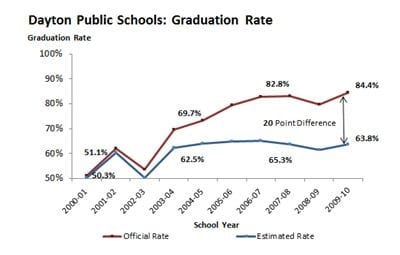
Source: Ohio Department of Education (official) and author's calculation (estimated)
The red line shows Dayton Public’s official graduation rate rising from 51 percent to 84 percent during the past decade; simultaneously, Dayton’s recovery charter enrollment grew by 600 percent. To estimate the impact that recovery charter growth has had on Dayton’s graduation rate, we assume that 75 percent of recovery charter students would have otherwise left the Dayton Public Schools without graduating. The blue line shows this estimated rate without recovery charters. The adjusted rate reduces Dayton Public’s graduation rate by up to 20 percentage points. (For more details about how the adjustment was made, see the report here.)
Perhaps even as important as recovery schools’ salutary effect on public school graduation rates, dropout recovery charters may directly benefit the students who attend public schools. How so? Underperforming students may have behavioral problems and may frequently disrupt student learning. If a public school district sees many of its most struggling and disruptive students migrate to dropout recovery schools, the student learning environment within its own walls should improve.
Third, assessing recovery charters’ performance should account for the fluid nature of their student attendance. The Performance Index (PI), an official performance metric and a widely quoted measure of school performance, shows how student attendance affects this indicator. Consider the 2010-11 PIs of two recovery charter:

Source: Ohio Department of Education, District Report Cards
We observe the very strong downward effect that untested students has on a school’s PI. (We suspect untested students were absent at during the exam period.) Cleveland Academy, which had a four percent untested rate, had a PI of 66. Meanwhile, Dayton Life Skills, with 46 percent of its students untested, reported a PI of 36. Thus, Cleveland’s higher PI may simply reflect higher attendance rates during examination time, not actual student performance.
We support the accountability provision in the Senate version of SB 316 to identify recovery charters that don’t serve their students’ needs. But we also ask legislators to consider recovery charters’ unique student composition, their benefits to public districts, and their testing challenges. This will take some smart thinking about how to assess recovery charters’ performance and whom to compare them with. And it will require careful consideration regarding sanctions for non-performing schools, and particularly, the consequences that closure would have on public schools.
We hope smart thinking will prevail. Colorado lawmakers have already implemented an “alternative accountability” system for its drop-out recovery charter schools, and we would encourage Ohio’s lawmakers to do the same. We highly recommend that lawmakers check out the testimony before the Ohio Senate on how to do this provided by the Colorado League of Charter Schools.
It is the aim of the Common Core (see above) that all students will be college- or career-ready by the time they graduate from high school. One organization working to make this goal a reality in Fordham’s hometown of Dayton is Learn to Earn Dayton. Last week the Fordham Institute teamed up with Learn to Earn Dayton to host a community conversation, “What does the Common Core Mean for Dayton and its Human Capital Development Strategies?”
The event brought together leaders from the business and education community to discuss the future of Dayton and the potential impact the Common Core can have on the city. The event featured Stan Heffner, state superintendent of public instruction; Mike Cohen, president of Achieve; Ellen Belcher, author of our recent report on Common Core implementation; and David Ponitz, president emeritus of Sinclair Community College and chairman of the board of the Thomas B. Fordham Institute.
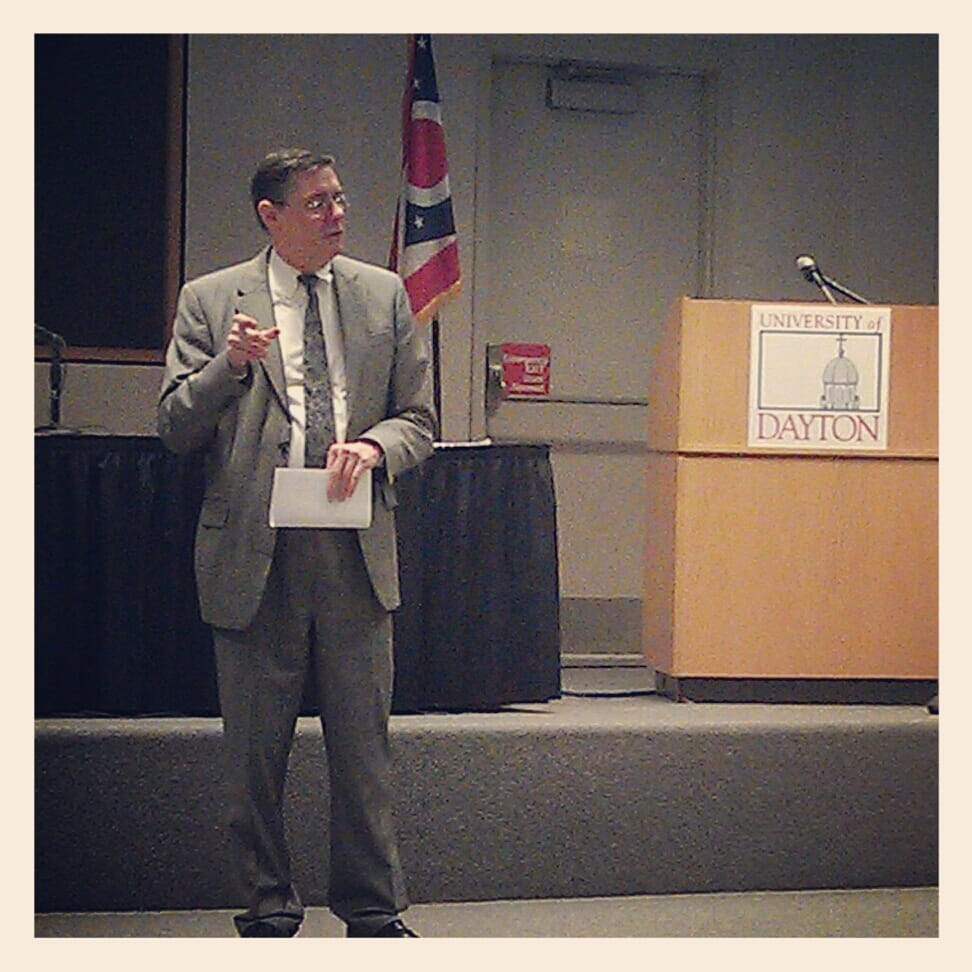

Stan Heffner, state superintendent of public instruction and Mike Cohen, president of Achieve
Superintendent Heffner explained that the Common Core standards will help Ohio move from the minimum toward a path that allows kids to be college and career ready. He acknowledged that the transition will be rough and that it will scare some people but in the end people will rise to the occasion, and kids will be asked to do more and better. Mike Cohen, one of the national leaders who has led the development of the Common Core, spoke of the national significance of these new academic standards. Cohen shared that the standards will set the expectations we want our students to learn and should drive and improve instruction. He also explained that while test scores will likely drop as the standards come on-line it would be wrong to retreat and weaken the standards or the assessment that go with them. Ellen Belcher closed out the event by highlighting some of the major findings from Future Shock: Early Common Core Lessons from Ohio (see above).
The need for higher academic standards is needed more now than ever. Dayton ranks 72nd in educational attainment among the top 100 largest metro areas in the US and only 14.4 percent of Dayton residents hold a bachelor’s degree. Nationally the city’s educational achievement in mathematics is lagging and by the twelfth grade we are at the bottom of the barrel compared to other countries.
The Common Core standards have the potential to help put Dayton, Ohio and the country on a path toward higher achievement. The Common Core is a necessary step forward and while the road to success might not be easy and surely won’t come without challenges it is essential for the future of children that we get it right.
Good news and bad news for the Buckeye State. The bad news first: in the recently-released “The Nation’s Report Card” for eighth grade science scores, Ohio fell eight spots in the state rankings. The good news: despite the drop, Ohio continued to outperform the national average in science scores.
Issued by the U.S. Department of Education, the Report Card publishes National Assessment of Educational Progress (NAEP) results and provides inter-state and year-to-year comparisons of student performance. Nationally, the results were encouraging as scores trended upwards and achievement gaps narrowed. (My colleague Daniela Fairchild reviews the national data here.)
Ohio’s 2011 average science test score remained flat compared to 2009, causing the Buckeye State to fall behind states whose test scores improved. However, Ohio still bests the national test average by seven points, and its average test scores also remain near the top among the states—fifteenth out of fifty. Additionally, Ohio continues to outperform the national percentage of students scoring “above proficient” and “above basic.”
These science scores are critical, for they predict our nation’s ability to meet the demands of the future marketplace. Ohio’s future, therefore, rests on how well it equips today’s kids with the scientific tools for tomorrow’s needs. Ohio’s mixed NAEP results—still a national leader in science scores but with a flat-line performance trend—should motivate the Buckeye State to continue its aggressive investment in kids’ science education. By investing in science, Ohio can plant the seeds for its economic future, today.
The Nation’s Report Card: Science 2011
U.S. Department of Education, Institute of Education Sciences
May 2012
In fall 2011, U.S. Secretary of Education Arne Duncan announced the administration’s decision to allow states to apply for waivers to the federal No Child Left Behind Act (NCLB) requirements. To receive consideration for these waivers states had to establish “college and career- ready” expectations, develop and implement differentiated accountability systems, and develop teacher and principal evaluations systems. The U.S. Department of Education granted waivers to eleven states during the first-round application process. Another 27 states currently have an application under consideration in the second round.
A recent report by the Center on Education Policy (CEP) takes a look at the major accountability themes proposed by the 27 states in the second round, focusing on common themes among these states.
CEP found that the waiver applications in general are more complex than the current provisions of NCLB. The following are among the major accountability themes detected in the applications:
Ohio was one of the 27 states that applied for a waiver during the second-round application process. As the CEP report suggests, Ohio’s application follows many of the major themes mentioned above. Ohio adopted the Common Core in 2010 and if its application is approved it would represent a major shift in the way schools and districts are graded, as well as dismantle the current tutoring program. Ohio’s application, like the other 26 states, represents a major shift in the current policies prescribed in NCLB.
Major Accountability Themes of Second-Round State Applications for NCLB Waivers
Center on Education Policy
May 2012
The New Teacher Project's (TNTP) Greenhouse Schools considers the link between a school’s instructional culture and both teacher retention and student achievement. TNTP surveyed 4,800 teachers in 250 schools nationwide (including charter schools) to determine what it calls “greenhouse schools”, or schools that nurture a great learning environment. These schools prioritize quality educators above all else, in attempts to foster the best learning environment possible. TNTP found that “greenhouse schools” keep more top teachers and get better results for students compared to schools with weaker instructional culture. The report then looks at what those schools are doing differently.
Based on its study, TNTP suggests that these are the principles for improving schools, using strong instructional culture as a foundation:
Principals and school leaders need to examine ways to improve their instructional culture, and then proceed to implement a plan to set these goals in motion.
Greenhouse Schools: How Schools Can Build Cultures Where Teachers and Students Thrive
The New Teacher Project
April, 2012
A report released by the Stanford Center for Opportunity Policy in Education advances the discussion about quality teacher evaluations and professional development within the greater context of a continuous learning system. Creating a Comprehensive System for Evaluating and Supporting Effective Teaching by Linda Darling-Hammond, argues for a high-quality teaching and student learning system that doesn’t simply focus on arbitrary value-added measures; rather, it follows these three objectives: (1) Supports all stages of teaching, (2) Relates seamlessly what teachers do in the classroom and how they are prepared and assessed, and (3) Develops teaching contexts that facilitate good practice in addition to identifying and rewarding effective teachers.
There are seven criteria necessary to achieve these goals:
These seven criteria create a cyclical system based on constant support and development. The feedback loop develops the best standards and teaching practices, supports administrators to be trained in observation and feedback, and supports professional development opportunities to help teachers explore new teaching practices. This constantly-churning system of communication and feedback can develop the best standards and teaching practices.
Although the Buckeye State has started down the path to quality teacher evaluations, there is still much work to be done. This report suggests a construct for high-quality teaching evaluation and professional development—and professional development matters: Less than 14 hours of teacher professional development a year on a topic had no effect on student learning. Yet, high-quality programs with 50 hours over a 6 to 12 month period increased student achievement by 21 percentage points on average.
Creating a Comprehensive System for Evaluating and Supporting Effective Teaching
Stanford Center for Opportunity Policy in Education
Linda Darling-Hammond
2012