Mobile Navigation

  • National
    • Policy
      • High Expectations
      • Quality Choices
      • Personalized Pathways
    • Research
    • Commentary
      • Gadfly Newsletter
      • Flypaper Blog
    • Events
    • Scholars Program
  • Ohio
    • Policy
      • Priorities
      • Media & Testimony
    • Research
    • Commentary
      • Ohio Education Gadfly Biweekly
      • Ohio Gadfly Daily
  • Charter Authorizing
    • Application
    • Sponsored Schools
    • Resources
  • About
    • Mission
    • Board
    • Staff
    • Career
Home
Home
Advancing Educational Excellence

Main Navigation

  • National
  • Ohio
  • Charter Authorizing
  • About

Ohio Menu

  • Topics
    • Accountability & Testing
    • Advanced Education
    • Career & Technical Education
    • Charter Schools
    • Curriculum & Instruction
    • ESSA
    • Evidence-Based Learning
    • Governance
    • Personalized Learning
    • Private School Choice
    • School Finance
    • Standards
    • Teachers & School Leaders
  • Research
  • Policy
  • Commentary
    • Ohio Gadfly Newsletter
    • Ohio Gadfly Blog
    • Events

The Education Gadfly Weekly

Sign Up to Receive Fordham Updates

We'll send you quality research, commentary, analysis, and news on the education issues you care about.
Thank you for signing up!
Please check your email to confirm the subscription.

Ohio Education Gadfly: Doing “more with less” demands partners, K-12 sector is finding them

Volume 5, Number 6
3.27.2012
3.27.2012

Ohio Education Gadfly: Doing “more with less” demands partners, K-12 sector is finding them

Volume 5, Number 6
view

Two education gems in the Gem City

Two outstanding high schools will be featured in a report looking at high-performing, high-poverty high schools: Dayton Early College Academy (a charter school) and Stivers Schools for the Arts (a district-operated magnet school).

Adrienne King 3.27.2012
OhioBlog

Two education gems in the Gem City

Adrienne King
3.27.2012
Blog

Primary Sources: 2012 America’s Teachers on the Teaching Profession

Bianca Speranza
3.27.2012
Blog

U.S. Education Reform and National Security

Adrienne King
3.27.2012
Blog

Strange political bedfellows coming together around Cleveland’s school-reform efforts

Terry Ryan
3.27.2012
Blog

Governor Kasich’s mid-biennium education proposals focus on performance, transparency

Emmy L. Partin
3.27.2012
Blog

Ohio’s “dropout factories”

Emmy L. Partin
3.27.2012
Blog

Two education gems in the Gem City

Adrienne King
3.27.2012
Blog

Primary Sources: 2012 America’s Teachers on the Teaching Profession

Bianca Speranza
3.27.2012
Blog

U.S. Education Reform and National Security

Adrienne King
3.27.2012
Blog
view

Primary Sources: 2012 America’s Teachers on the Teaching Profession

Bianca Speranza 3.27.2012
Blog
view

U.S. Education Reform and National Security

Adrienne King 3.27.2012
Blog
view

Strange political bedfellows coming together around Cleveland’s school-reform efforts

Terry Ryan 3.27.2012
Blog
view

Governor Kasich’s mid-biennium education proposals focus on performance, transparency

Emmy L. Partin 3.27.2012
Blog
view

Ohio’s “dropout factories”

Emmy L. Partin 3.27.2012
Blog
view

Two education gems in the Gem City

Adrienne King 3.27.2012
Blog
view

Primary Sources: 2012 America’s Teachers on the Teaching Profession

Bianca Speranza 3.27.2012
Blog
view

U.S. Education Reform and National Security

Adrienne King 3.27.2012
Blog
view

Two education gems in the Gem City

Adrienne King
3.27.2012
Blog

Our May 2010 report Needles in a Haystack: Lessons from Ohio’s high-performing, high-need urban schools profiled successful elementary schools that serve challenging populations. Due to the overwhelming positive response, we have commissioned a follow-up report that looks at high-performing urban high schools. Peter Meyer – journalist, author, and senior policy fellow at Fordham – has been traveling to the selected schools to chronicle what makes them work. (He wrote a bit about his experiences at these schools in January.)

We’ve been working to improve the education landscape in our hometown of Dayton for nearly twelve years. The work is never easy and often frustrating. We were disappointed two years ago not to be able to feature a Dayton elementary school in our report. Thus we are pleased to be featuring two outstanding high schools there in this edition: Dayton Early College Academy (a charter school) and Stivers Schools for the Arts (a district-operated magnet school).

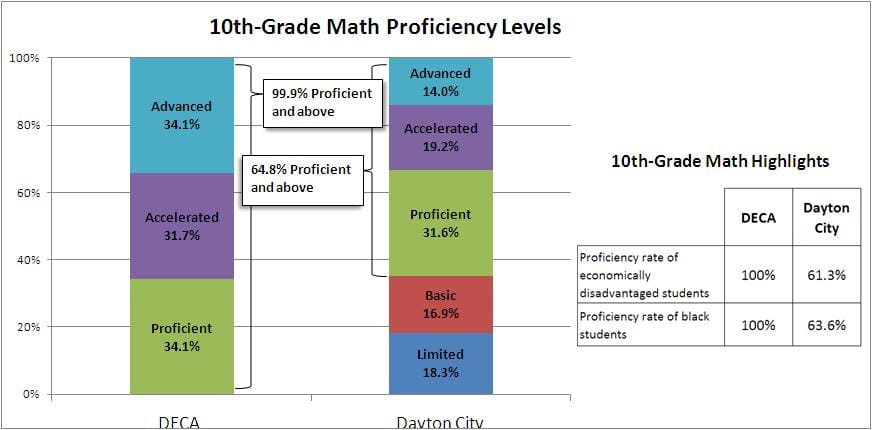
The charts below compare DECA’s and Stivers’ tenth-grade students’ performance on the math section of last year’s Ohio Graduation Test to their peers in the Dayton Public School district. The OGT certainly isn’t known for its rigor and we don’t want to overstate a school’s excellence based on its performance on that test. But these results do make clear that DECA and Stivers are delivering their students to far higher levels of achievement than the district as a whole. We’re pleased by their successes and look forward to sharing more about these two schools, and four others, in our report. Watch for its release toward the end of this school year.

Source: Ohio Department of Education PowerUsers Report, accessed March 21, 2012.

view

Primary Sources: 2012 America’s Teachers on the Teaching Profession

Bianca Speranza
3.27.2012
Blog

Ever wonder what teachers think about issues such as student and teacher performance and how teachers should be evaluated, rewarded, and supported? A recent report from Scholastic and the Bill & Melinda Gates Foundation, Primary Sources: 2012 America’s Teachers on the Teaching Profession, attempts to answer those questions and more. Over 10,000 teachers responded to online survey aimed at identifying the supports and tools that directly impact student achievement, the way teacher’s benchmark their success, and the tools necessary to retain good teachers.

The results can be summed up into four beliefs:

  • Raising student achievement requires the work of many. Teachers know that they are the single most important factor in raising student achievement, 99 percent of teachers responded saying that “effective and engaged” teachers are absolutely essential. Teachers also identified the importance of setting the bar high and creating high expectations for all students as an essential component to moving the achievement needle- 71 percent of teachers said that “high expectations for all students” make a very strong impact. Family involvement and effective school leaders also ranked significantly high as having an impact on student achievement.
  • Teaching and learning are too complex to be measured by one test. Teachers understand and value the importance of measuring student achievement but clearly stated that standardized test are not the best tool to do so- only 26 percent of teachers believe that standardized tests are an accurate reflection of student achievement. Teachers also recognize the need to measure their performance in the classroom, but are cautious of using standardized tests as a single indicator of their success. Instead they believe that they should be evaluated through a variety of methods including student growth measurements and parent and peer reviews.
  • Challenges facing America’s schools are significant and growing. Teachers reported that more students are struggling academically and socially. While 82 percent of teachers said that the goal of K-12 was for students to graduate college- and career-ready, only 63 percent believe that their current students would leave high school prepared for college. Teachers are also seeing a rise in the number of behavioral, poverty, and hunger challenges among students.
  • School and community supports are essential to keeping good-teachers in the classroom. Much like the factors important for raising student achievement, teachers believe that supportive school leaders, engaged parents, and a quality curriculum are key to retaining good teachers. Other factors such as a collaborative work environment and support staff were reported as important as well.

While teachers are facing more and more challenges in the classroom they are still content with their chosen profession, with over 80 percent reporting they are satisfied with their jobs.

view

U.S. Education Reform and National Security

Adrienne King
3.27.2012
Blog

The claim that our nation’s schools too often fail to educate enough students to high levels of achievement is a bit of a broken record. The “U.S. Education Reform and National Security” report by the Council on Foreign Relations puts a new spin on that tune. The report details why a poor public education system is a threat to U.S. national security and the actual and potential impact our schools have on our nation’s future.

The report finds five major threats an inadequate K-12 education system poses to national security:

  • Threats to economic growth and competitiveness – Today, only about 75 percent of Americans graduate from high school. With only semi-skilled citizens, the fully developed workforce is not consistently renewing and expanding itself, leaving the U.S. quality talent pool stagnant or declining while other countries’ work forces are progressing.
  • Threats to U.S. physical safety- About 75 percent of young Americans are not qualified to join the military because they dropped out of high school, are obese or have other physical constraints, or have criminal records. Of those eligible to apply to the military, 30 percent fail the Armed Services Aptitude Battery, a test that anticipates a person’s service success based on verbal, math, science, and technical skill.
  • Threats to intellectual property- Sensitive U.S. documents are constantly under attack from foreign hackers. There are not enough technologically qualified candidates to help protect the data systems from these hackers.
  • Threats to U.S. global awareness- The Government Accountability Office released a report documenting the discrepancy in foreign languages among military officers. These cross-cultural skills are necessary to interact with local communities and anticipate challenges. In Afghanistan, 33 of 45 officers in language-designated positions did not meet the State Department’s language requirements. In Iraq, 8 of 14 officers did not have the requirements.
  • Threats to U.S. unity and cohesion- For the first time, Americans think it is unlikely the youth today will have a better life than their parents. The widening socioeconomic achievement gap is a trend that makes the American Dream more out of reach and breeds fear and isolation.

So what is our country, or state, to do? The report offers three major recommendations. Here’s how they stack up against current education policies in Ohio:

Report Recommendations

Actions in Ohio

1. Implement educational expectations in subjects vital to protecting national security. 1. Ohio is transitioning to the Common Core State Standards in math and English Language Arts and revising its standards across the board to raise rigor and expectation.
2.Make structural changes to provide   students with good choices. 2. Teach For America will launch its first Ohio corps next school year, our voucher programs have been expanded dramatically in the past year, the state is ratcheting up performance requirements on all public schools, and local efforts like Mayor Jackson’s plan for Cleveland are helping to support high-performing schools regardless of type.
3. Launch a “national security readiness audit” to hold schools and policymakers accountable for results and to raise public awareness. 3. Ohio has put in place a series of new accountability provisions to better hold educators and schools accountable for improving student academic performance.
view

Strange political bedfellows coming together around Cleveland’s school-reform efforts

Terry Ryan
3.27.2012
Blog

Cleveland Mayor Frank Jackson is seeking to remake and refashion the city’s long-suffering schools through a series of bold reforms that include making significant changes to the district’s collective bargaining agreement, passing a school levy for the first time in more than 15 years, and sharing public dollars with high-performing charter schools. As bold as the Jackson Plan is, however, even more audacious is the political coalition that seems to be coalescing around it.

Controversial components of the mayor’s plan include basing pay, layoffs, and rehiring decisions on performance and specialization instead of traditional factors like seniority and credentials; replacing the current 304-page collective bargaining agreement, when it expires in 2013, and using a “fresh start” to renegotiate a new and far more streamlined contract; and providing high-performing charter schools with local levy dollars to support their day-to-day operations.

The Jackson Plan’s labor flexibility and levy support for high-performing charter schools are ideas that have long been anathema to statehouse Democrats and their union supporters. Not surprisingly, more than a few legislative Democrats and union officials have noted in recent weeks that some of the proposed changes in the mayor’s plan to the Cleveland teacher union collective bargaining agreement mirror those that were in the contentious and voter rejected Senate Bill 5. Democrats in both the House and Senate vehemently opposed Senate Bill 5 from its introduction to its demise (as did Mayor Jackson) in November. Further, organized labor, led by the teachers’ unions, raised over $20 million to help “kill the bill.”

Now, statehouse Democrats and organized labor are being asked by Mayor Jackson to sign off on changes to law that they worked so hard to kill just months ago. Why has the mayor put his Democratic colleagues in such an uncomfortable position? Because he believes, and evidence from successful school reform efforts in other big cities backs him up, that his proposed changes would give Cleveland Metropolitan School District CEO Eric Gordon the flexibility he and his team need to keep and build the strongest teaching force possible.

Mayor Jackson has said repeatedly that his plan is not about politics, it is about the children of Cleveland and what they need and deserve. The fact that his plan has some policy proposals around labor and management that mirror what was in Senate Bill 5 doesn’t matter to him if these policies result in higher performing schools. This position is hard for many Democrats and the teachers’ union to stomach, but to their credit both seem to be working with the mayor and his leadership team to find a way to do it.

No one denies that Cleveland’s students are suffering and strong medicine is needed to try and turn things around in a city that has floundered from failed reform to failed reform for decades. Student performance in Cleveland is abysmal. The Trial Urban District Assessment (TUDA) results (on the NAEP – National Assessment of Educational Progress), for example, are considered the Gold Standard for looking at student achievement in mathematics and reading across 21 of the nation’s large urban districts. Cleveland’s students are bottom dwellers on these exams (as they are on state exams). Recent TUDA results showed that 68 percent of Cleveland’s fourth graders scored at below basic level in reading compared to 45 percent of students in the other large cities and 34 percent nationally. The numbers are even worse in mathematics.

The Jackson Plan offers the possibility of success because it is multifaceted, systemic, and forces change across the city’s educational landscape. Poor-performing schools face radical restructuring or closure while quality schools will receive more resources to expand what they do. The central office will be asked to streamline its operations and operate more efficiently while teachers will be rewarded, supported and held accountable for performance. Taxpayers will be asked to support a new levy request, and if all goes according to plan children in the city will receive stronger and better learning opportunities.

There looks to be an emerging bipartisan political consensus from Cleveland to Columbus that doing nothing is not an option, and that some form of Mayor Jackson’s plan is the best hope for improving education in Cleveland and stanching the flow of families out of the city. Democrats and Republicans at the statehouse are coming together to show support for the Jackson Plan, and if legislative language acceptable to both the mayor and the Cleveland Teachers Union (CTU) can be presented to the legislature it has a real shot at becoming law. Time is of the essence here as legislation would have to be passed in time for the school district to file a levy request in August. For this to happen, a bill has to be presented to the General Assembly by the end of this week and passed by mid-Spring.

In a remarkable bipartisan show of support for finding a plan that works for both the mayor and the CTU conversations have been ongoing in Cleveland and Columbus among northern Ohio lawmakers, Mayor Jackson, and the Cleveland Teachers Union. The discussions have been led by Senator Nina Turner (D-Cleveland) and Senator Peggy Lehner (R- Kettering, and chair of the Senate Education Committee). Joining the Senators in leading these conversations have been Republican House Finance and Appropriations Chairman Ron Amstutz and Democratic State Representative Sandra Williams (head of the Legislative Black Caucus).

Such bipartisan leadership in search of solutions to thorny issues in Ohio has been sorely lacking in recent years. The fact that this is happening in an election year is all the more remarkable. Of course this could all fall apart (and maybe will have by the time you read this), but all sides seem serious about finding a deal. Maybe, just maybe, real school reform in Ohio can move forward in a bipartisan way. That would be a good thing for not only Cleveland but Ohio. Our state does not lack a shortage of tough issues to tackle that will demand some level of bipartisan effort to resolve.

view

Governor Kasich’s mid-biennium education proposals focus on performance, transparency

Emmy L. Partin
3.27.2012
Blog

The education provisions of Governor Kasich’s “mid-biennium review” (Senate Bill 316) had their first hearing in the Senate education committee yesterday. The proposals range from small, administrative fixes to sweeping policy changes. There had been much speculation that November's sound defeat of S.B. 5 by Ohio voters would cause Kasich and fellow Republicans to shy away from tough or controversial measures; a quick review of SB 316 shows that isn't the case.

In a nutshell, it is fair to say that all of the governor’s major education proposals are aimed at making sure everyone – educators, parents, and the public – has a clearer and more accurate understanding of how well Ohio’s schools are doing in preparing students for college and the workforce. For example, SB 316 would shine more light on the performance of Ohio’s schools by:

  • Putting in place a new A-F school-rating system that is easier for parents and the public to understand and which more accurately reflects schools’ and districts’ true performance. This change is part of an overall effort to prepare Ohioans for the more rigorous academic standards and assessments that are coming down the pike in the form of the Common Core academic standards.
  • Requiring performance standards for drop-out recovery charter schools and career-technical schools that recognize the differences between these schools and “traditional” district and charter schools. Drop-out recovery schools have been exempted from Ohio’s charter school academic death penalty and other accountability measures since their inception more than a decade ago. Career-technical schools have not been issued state ratings and report cards in the same manner as other schools.
  • Assessing the quality of public early childhood programs by requiring them to participate in the state’s tiered quality rating system. Students in these programs would also be issued individual “statewide student ID” numbers (just as K-12 public school students are) so that data will be available to measure early learning programs’ success in preparing children for kindergarten.
  • Strengthening the “third-grade reading guarantee” to ensure that students aren’t socially promoted to fourth grade without necessary reading comprehension skills. Ohio’s current reading guarantee has been decried as an unfunded mandate by local schools and gone largely unenforced. Kasich’s version raises the bar for students to be allowed to progress to fourth grade and specifies additional interventions (like intensive summer school) that schools are required to offer to struggling readers. Under the plan, parents would receive more information from their child’s school in grades K-2 about their child’s progress, or lack thereof, toward meeting the third-grade proficiency standard in reading.
  • Making public the success of Ohio’s teacher training programs by requiring the Chancellor of the Board of Regents to publish the number and percentage of graduates of each program by teacher-evaluation rating level. The bill makes further small adjustments to current teacher evaluation and testing requirements in order to make them more meaningful and workable at the local level.

Additionally, the bill would:

  • Require the development of standards for blended-learning (aka hybrid) education models.
  • Change how charter school sponsor performance is measured by requiring separate rankings for sponsors of conversion schools (primarily school districts) and sponsors of start-up schools. The bottom 20 percent of sponsors in each category would be prohibited from opening a new school until their portfolio’s performance improved.
  • Extend the deadline for the state to adopt school expenditure standards and for determining and comparing districts’ spending on classroom versus non-classroom expenses.
  • Require the state to integrate “career connections” into model curricula to better prepare and encourage students to pursue post-graduate opportunities other than four-year college.
  • Clarify that the “parent trigger” pilot in the Columbus City Schools would prevail over other restructuring options for low-performing schools should a school be eligible for both.

Governor Kasich still has yet to tackle a few areas of education policy that need attention here (school funding first and foremost; and separate legislation is expected as early as this week regarding Mayor Jackson’s Plan for Cleveland’s schools), but there is much to like in what the governor has put forth. Hearings by topic area will continue in the Senate education committee over coming weeks. Lawmakers will put their own stamp on the bill as it moves through the legislature, which is expected to happen swiftly because several major provisions need to be in place before the start of next school year yet much of the bill cannot take effect until 90 days after it is signed by the governor.

view

Ohio’s “dropout factories”

Emmy L. Partin
3.27.2012
Blog

In 2009, 135 Ohio high schools were identified as “dropout factories” – schools that fail to graduate more than 60 percent of their students on time. Further, despite an increase in the state’s overall graduation rate, Ohio saw a greater increase in the number of dropout factories than any other state from 2002 to 2009 (jumping from 75 to 135). These troubling findings come from the annual Building a Grad Nation report, issued this week by Civic Enterprises, the Everyone Graduates Center at Johns Hopkins University, America’s Promise Alliance, and the Alliance for Excellent Education.

New York and Tennessee lead the nation in their overall increase in graduate rates, which have jumped 13 and 18 percentage points respectively from 2002 to 2009. (Ohio’s rate increased 2.1 points in that time.) Nationally, the number of dropout factories has declined by 457 since 2002 (to 1,550 such schools today). Texas leads the nation in moving schools off the list, with 122 fewer dropout factories in 2009 than 2002. Another seven states moved more than twenty schools off the list.

But back to Ohio… what schools are the Buckeye State’s dropout factories? The report doesn’t list them, but using publicly available graduation rate data we can get an idea of what buildings they are and where they are located.

In 2009-10, 805 Ohio public high schools received a graduation rate calculation from the state. (Ohio, like many states, provided two graduation rates for that year: a state-calculated rate and a federally required “adjusted cohort graduation rate” (ACGR), the latter offering a more accurate number of how many students complete high school. For the purposes of this analysis, we are using the ACGR, the rate favored by the report’s authors.)

Of those 800-plus schools, 117 failed to graduate more than 60 percent of the class of 2010 on time. You can click here to see a full table of these schools, and here are a few interesting facts about who they are:

  • Sixty-two of the schools are rated by the state as one might expect (Academic Watch or Academic Emergency, the state’s lowest two ratings; another 11 are not rated at all), BUT
  • Nine received one of the state’s highest two ratings. In fact, four schools achieved an Excellent rating despite their dismal graduation rates.
  • Not unexpectedly, all five of the high schools located in the state’s juvenile correctional facilities made the list.
  • The majority of the schools (73 of them) are charter schools, including many of the state’s drop-out recovery schools, which are explicitly focused on getting at-risk students to graduation, and the state’s largest online schools.
  • The district schools on the list are centered in Ohio’s major urban areas and a few mid-sized cities whose students often face similar challenges as their peers in the urban centers. Cincinnati City Schools and Cleveland Metropolitan Schools lead the pack with seven and eight schools on the list respectively. (The report features a special look at Cleveland and the urgency to revitalize that school district and city.)

The report is chock full of more data, case studies of successful dropout prevention efforts, benchmarks for assessing progress toward improving graduation rates, and policy recommendations. It offers ten state-level policy suggestions, many of which Ohio has enacted (like setting the maximum compulsory education age at 18, not 16) or is in the process of adopting (e.g., transitioning to the adjusted cohort graduation rate and improving preschool through college data systems). The report’s authors recommend that Ohio should also do more to track and publicize chronic absenteeism at the school, district, and state levels, and should put “early warning indicators and intervention systems” in place at all districts that are home to low-graduate-rate high schools.

view

Two education gems in the Gem City

Adrienne King
3.27.2012
Blog

Our May 2010 report Needles in a Haystack: Lessons from Ohio’s high-performing, high-need urban schools profiled successful elementary schools that serve challenging populations. Due to the overwhelming positive response, we have commissioned a follow-up report that looks at high-performing urban high schools. Peter Meyer – journalist, author, and senior policy fellow at Fordham – has been traveling to the selected schools to chronicle what makes them work. (He wrote a bit about his experiences at these schools in January.)

We’ve been working to improve the education landscape in our hometown of Dayton for nearly twelve years. The work is never easy and often frustrating. We were disappointed two years ago not to be able to feature a Dayton elementary school in our report. Thus we are pleased to be featuring two outstanding high schools there in this edition: Dayton Early College Academy (a charter school) and Stivers Schools for the Arts (a district-operated magnet school).

The charts below compare DECA’s and Stivers’ tenth-grade students’ performance on the math section of last year’s Ohio Graduation Test to their peers in the Dayton Public School district. The OGT certainly isn’t known for its rigor and we don’t want to overstate a school’s excellence based on its performance on that test. But these results do make clear that DECA and Stivers are delivering their students to far higher levels of achievement than the district as a whole. We’re pleased by their successes and look forward to sharing more about these two schools, and four others, in our report. Watch for its release toward the end of this school year.

Source: Ohio Department of Education PowerUsers Report, accessed March 21, 2012.

view

Primary Sources: 2012 America’s Teachers on the Teaching Profession

Bianca Speranza
3.27.2012
Blog

Ever wonder what teachers think about issues such as student and teacher performance and how teachers should be evaluated, rewarded, and supported? A recent report from Scholastic and the Bill & Melinda Gates Foundation, Primary Sources: 2012 America’s Teachers on the Teaching Profession, attempts to answer those questions and more. Over 10,000 teachers responded to online survey aimed at identifying the supports and tools that directly impact student achievement, the way teacher’s benchmark their success, and the tools necessary to retain good teachers.

The results can be summed up into four beliefs:

  • Raising student achievement requires the work of many. Teachers know that they are the single most important factor in raising student achievement, 99 percent of teachers responded saying that “effective and engaged” teachers are absolutely essential. Teachers also identified the importance of setting the bar high and creating high expectations for all students as an essential component to moving the achievement needle- 71 percent of teachers said that “high expectations for all students” make a very strong impact. Family involvement and effective school leaders also ranked significantly high as having an impact on student achievement.
  • Teaching and learning are too complex to be measured by one test. Teachers understand and value the importance of measuring student achievement but clearly stated that standardized test are not the best tool to do so- only 26 percent of teachers believe that standardized tests are an accurate reflection of student achievement. Teachers also recognize the need to measure their performance in the classroom, but are cautious of using standardized tests as a single indicator of their success. Instead they believe that they should be evaluated through a variety of methods including student growth measurements and parent and peer reviews.
  • Challenges facing America’s schools are significant and growing. Teachers reported that more students are struggling academically and socially. While 82 percent of teachers said that the goal of K-12 was for students to graduate college- and career-ready, only 63 percent believe that their current students would leave high school prepared for college. Teachers are also seeing a rise in the number of behavioral, poverty, and hunger challenges among students.
  • School and community supports are essential to keeping good-teachers in the classroom. Much like the factors important for raising student achievement, teachers believe that supportive school leaders, engaged parents, and a quality curriculum are key to retaining good teachers. Other factors such as a collaborative work environment and support staff were reported as important as well.

While teachers are facing more and more challenges in the classroom they are still content with their chosen profession, with over 80 percent reporting they are satisfied with their jobs.

view

U.S. Education Reform and National Security

Adrienne King
3.27.2012
Blog

The claim that our nation’s schools too often fail to educate enough students to high levels of achievement is a bit of a broken record. The “U.S. Education Reform and National Security” report by the Council on Foreign Relations puts a new spin on that tune. The report details why a poor public education system is a threat to U.S. national security and the actual and potential impact our schools have on our nation’s future.

The report finds five major threats an inadequate K-12 education system poses to national security:

  • Threats to economic growth and competitiveness – Today, only about 75 percent of Americans graduate from high school. With only semi-skilled citizens, the fully developed workforce is not consistently renewing and expanding itself, leaving the U.S. quality talent pool stagnant or declining while other countries’ work forces are progressing.
  • Threats to U.S. physical safety- About 75 percent of young Americans are not qualified to join the military because they dropped out of high school, are obese or have other physical constraints, or have criminal records. Of those eligible to apply to the military, 30 percent fail the Armed Services Aptitude Battery, a test that anticipates a person’s service success based on verbal, math, science, and technical skill.
  • Threats to intellectual property- Sensitive U.S. documents are constantly under attack from foreign hackers. There are not enough technologically qualified candidates to help protect the data systems from these hackers.
  • Threats to U.S. global awareness- The Government Accountability Office released a report documenting the discrepancy in foreign languages among military officers. These cross-cultural skills are necessary to interact with local communities and anticipate challenges. In Afghanistan, 33 of 45 officers in language-designated positions did not meet the State Department’s language requirements. In Iraq, 8 of 14 officers did not have the requirements.
  • Threats to U.S. unity and cohesion- For the first time, Americans think it is unlikely the youth today will have a better life than their parents. The widening socioeconomic achievement gap is a trend that makes the American Dream more out of reach and breeds fear and isolation.

So what is our country, or state, to do? The report offers three major recommendations. Here’s how they stack up against current education policies in Ohio:

Report Recommendations

Actions in Ohio

1. Implement educational expectations in subjects vital to protecting national security. 1. Ohio is transitioning to the Common Core State Standards in math and English Language Arts and revising its standards across the board to raise rigor and expectation.
2.Make structural changes to provide   students with good choices. 2. Teach For America will launch its first Ohio corps next school year, our voucher programs have been expanded dramatically in the past year, the state is ratcheting up performance requirements on all public schools, and local efforts like Mayor Jackson’s plan for Cleveland are helping to support high-performing schools regardless of type.
3. Launch a “national security readiness audit” to hold schools and policymakers accountable for results and to raise public awareness. 3. Ohio has put in place a series of new accountability provisions to better hold educators and schools accountable for improving student academic performance.
Fordham Logo

© 2026 The Thomas B. Fordham Institute
Privacy Policy
Usage Agreement

National

P.O. Box 110
Burke, VA 22009

202.223.5452

[email protected]

Ohio

P.O. Box 82291
Columbus, OH 43202

614.223.1580

[email protected]

Sponsorship

130 West Second Street, Suite 410
Dayton, Ohio 45402

937.227.3368

[email protected]