Note: Today, the Ohio Senate’s Education Committee heard testimony on Substitute House Bill 33, the state’s budget bill for fiscal years 2024 and 2025. Fordham’s Ohio Research Director provided this written testimony on two important provisions of the bill.
My name is Aaron Churchill, and I am the Ohio Research Director at the Thomas B. Fordham Institute. The Fordham Institute is an education-focused nonprofit that conducts research, analysis, and policy advocacy with offices in Columbus, Dayton, and Washington, D.C. Our Dayton office, through the affiliated Thomas B. Fordham Foundation, is also a community (charter) school sponsor.
In this year’s budget bill, Governor DeWine and House lawmakers have commendably made K–12 education a top priority. Together, they’ve put forward strong proposals that aim to improve student achievement and empower families with quality choices. We are especially supportive of the following provisions:
- Ensuring that elementary schools—as well as the universities that train teachers—follow proven instructional methods, often known as the science of reading.
- Increasing state investments in high-quality career-technical education.
- Expanding eligibility for the state’s EdChoice scholarship program.
If passed, these measures will ensure that more Ohio students are successful in school and ready for college and career.
In my comments below, I wish to focus on two additional steps that we respectfully urge the Senate to take that would strengthen the bill. They are as follows:
- Go further in bridging the charter school funding gap.
- Preserve Ohio’s third grade reading retention requirement.
The charter school funding gap
Ohio has historically left charter schools under-resourced, providing them with approximately 30 percent less per-pupil compared to local districts. Such a wide gap puts charter schools—and the students they serve—at a significant disadvantage. Without equitable funding, charters often struggle to provide the extra supports and enrichment opportunities that can unlock students’ full potential. They also face challenges in attracting and retaining talented teachers, as they’re left paying less competitive wages. Finally, the gap limits charters’ ability to expand and reach more Ohio students in need of a great education.
In recent years, Ohio’s Quality Community (Charter) School Support Fund has helped to narrow the funding gaps for schools that qualify for the additional state aid via strong report card ratings. Today, about one-third of brick-and-mortar charters—114 out of 314 statewide—receive the much-needed support. Led by Governor DeWine, HB 33 would wisely boost the per-student amounts provided to schools qualifying for these funds.
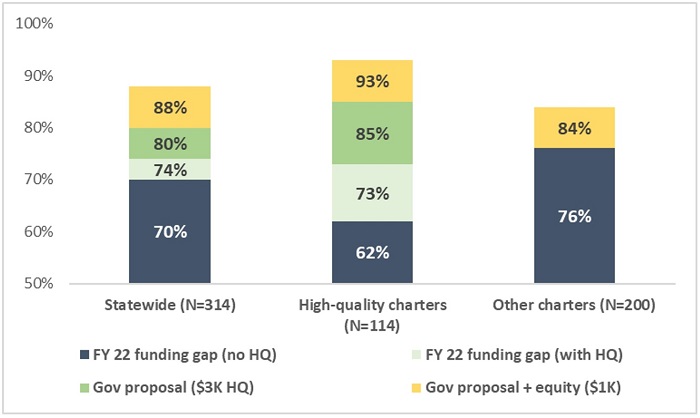
But even with this proposed increase, the average high-quality charter school would still fall short of funding parity with local districts. Other brick-and-mortar charters would continue face daunting gaps of almost 25 percent, as they receive no supplemental aid. Many of these schools serve large numbers of low-income and special-education students; some focus on serving adolescents who have dropped out. To provide fairer funding for all charter students, we ask you to support a $1,000 per pupil equity supplement for all brick-and-mortar charters in the state, in addition to Governor DeWine’s proposed increase for the high-quality charter fund. As Figure 1 below indicates, an equity supplement—in combination with the enhanced high-quality funding—would bring charters overall to an average of 88 percent of the per-pupil funding of local districts. This more modest shortfall would track closely with the funding differentials in states with strong charter sectors such as Massachusetts and Texas.[1]
Figure 1: Impact of a charter school equity supplement[2]
Retain Ohio’s third grade reading retention requirement
We are deeply concerned about the budget bill’s proposed elimination of the third grade reading retention requirements. Enacted by Ohio lawmakers in 2012, this provision, which is the heart of the Third Grade Reading Guarantee, aims to ensure that students with severe reading deficiencies aren’t falling through the cracks. The policy requires schools to give struggling students the extra time and intensive interventions needed to become strong readers.
The alternative to retention is “social promotion,” a harmful practice that hurts students in the long-run. The data are clear: Children who cannot read proficiently at the end of third grade are far more likely to struggle in middle and high school. Many will unfortunately choose to drop out,[3] which is associated with hardship as adults, such as increased unemployment, depressed wages, worsened mental and physical health, and increased rates of criminal behavior.[4]
Fortunately, rigorous studies from multiples states (including Ohio) indicate that third-grade retention significantly improves the academic outcomes of retained students. Relying on a statistical method that compares the academic progress of retained students to extremely similar students who narrowly pass the state’s third grade reading requirement, studies from Florida, Indiana, and Mississippi show that students who were held back outperform their closely matched peers in middle school and even into high school.[5]
We now have this same finding right here in Ohio. In a new study, the Ohio Education Research Center at Ohio State University finds that children who were held back under the Third Grade Reading Guarantee made significantly more progress in both reading and math than their peers who narrowly passed the promotional bar. The immediate effects of retention in fourth and fifth grade are substantial, roughly equivalent to gains of one achievement level on state exams relative to their non-retained peers. The gains moderate slightly thereafter, but remain statistically significant through seventh grade (the last grade that researchers were able to track).
A growing body of research, including from our own backyard, demonstrates that giving children extra time and supports puts them on surer pathways to success. Now is not the time to pull the plug on a policy that benefits students who are struggling to read. Every child deserves to read proficiently. Preserving this requirement will continue to guarantee early intervention for children who most need the extra time and help, and give them opportunities to reach their full potential. This is especially critical in the aftermath of the pandemic, when a record number of students are reaching third grade with limited reading skills.
The K–12 education provisions in House Bill 33 hold significant promise for Ohio students. With some finishing touches, especially those discussed above, the legislation will further ensure that every student receives the education they need to succeed in life.
Thank you again for the opportunity to submit written testimony.
[2] More detail about these calculations is at: https://fordhaminstitute.org/ohio/commentary/ohio-narrowing-charter-funding-gap-it-still-needs-do-more.