
Mobile Navigation

  • National
    • Policy
      • High Expectations
      • Quality Choices
      • Personalized Pathways
    • Research
    • Commentary
      • Gadfly Newsletter
      • Flypaper Blog
    • Events
    • Scholars Program
  • Ohio
    • Policy
      • Priorities
      • Media & Testimony
    • Research
    • Commentary
      • Ohio Education Gadfly Biweekly
      • Ohio Gadfly Daily
  • Charter Authorizing
    • Application
    • Sponsored Schools
    • Resources
  • About
    • Mission
    • Board
    • Staff
    • Career
Home
Home
Advancing Educational Excellence

Main Navigation

  • National
  • Ohio
  • Charter Authorizing
  • About

Ohio Menu

  • Topics
    • Accountability & Testing
    • Advanced Education
    • Career & Technical Education
    • Charter Schools
    • Curriculum & Instruction
    • ESSA
    • Evidence-Based Learning
    • Governance
    • Personalized Learning
    • Private School Choice
    • School Finance
    • Standards
    • Teachers & School Leaders
  • Research
  • Policy
  • Commentary
    • Ohio Gadfly Newsletter
    • Ohio Gadfly Blog
    • Events

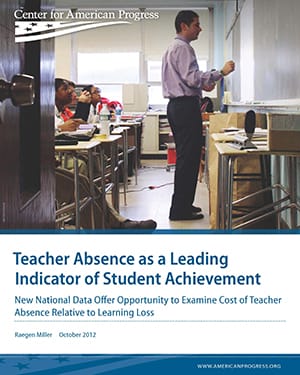
Teacher Absence as a Leading Indicator of Student Achievement

Daniela Fairchild
11.7.2012

The sun rises in the East. Grass is green. And teachers are the most important in-school factor in determining student achievement. This last truth has long guided the push for more robust teacher-preparation programs, heartier evaluation systems, and altered HR policies. This short report by Raegen Miller highlights another strategy, small but fruitful, for eking more out of today’s instructional workforce: Ensure that teachers come to school each day. Using data from the Civil Rights Data Collection survey, Miller discovers that, on average, 36 percent of teachers were absent (whether for sick or disability leave or vacation time) ten or more days during the 2009-10 school year. Nationally, these missed school days cost taxpayers $4 billion. Interestingly, about two-thirds of the variance in chronic-absenteeism rates exists between districts within states—highlighting the power that district policies and bargaining agreements play in determining these rates. (In that vein: Charter-school teachers were 15 percentage points less likely to be truant than their peers in district schools.) Miller further dissects the data by school level and student race (predominantly black schools face higher rates of teacher absenteeism), but he stops short of analyzing them by socioeconomic status—a key shortcoming of the report. (The coarse data necessarily used here leave further questions unanswered regarding total amount of leave taken and type of leave requested.) While not a comprehensive assessment, Miller’s report does bring this key inadequacy in K-12 education to the fore—and reveals some startlingly stark information.

SOURCE: Raegen Miller, Teacher Absence as a Leading Indicator of Student Achievement (Washington, D.C.: Center for American Progress, November 2012).

Tags: Center for American Progress Washington

Daniela was the development manager and policy analyst for the Fordham Institute. Donning many hats at Fordham prior to this role, Daniela had worked as a research intern, research assistant, and interim new-media manager. She started her career as a teacher of students with emotional and behavioral disabilities, and as a high school rowing coach. Prior to joining forces with TBFI, Daniela was a Global Development…

View Full Bio
Fordham Logo

© 2026 The Thomas B. Fordham Institute
Privacy Policy
Usage Agreement

National

P.O. Box 110
Burke, VA 22009

202.223.5452

[email protected]

Ohio

P.O. Box 82291
Columbus, OH 43202

614.223.1580

[email protected]

Sponsorship

130 West Second Street, Suite 410
Dayton, Ohio 45402

937.227.3368

[email protected]