
Today we continue our analysis of the impact of Governor Kasich’s mid-biennium education policy proposals with a look at how it would change the state’s charter school academic death penalty. (See our previous analyses of how schools would fare under the new A to F rating system and how that rating system could impact eligibility for the EdChoice Scholarship Program.)
Ohio has had an automatic charter school closure law on the books since late 2006. Currently the law states that a charter school (not including drop-out recovery schools or schools primarily serving students with disabilities) must shut its doors if it meets one of the following criteria:
- The school doesn’t offer a grade lever higher than three and has been declared to be in state of academic emergency for three of the four most recent years;
- The schools offers any of grade levels four to eight but does not offer a grade level higher than nine and has been in a state of academic emergency for two of the three most recent years and in at least two of the threeost recent years, the school showed less than one standard year of academic growth in either reading or math;
- The school offers any of grade levels ten to twelve and has been in a state of academic emergency for three of the four most recent school years.
Under these stipulations, 20 schools have been subject to automatic closure. If the current version of SB 316 were to take effect, those schools could soon get a lot of company.
Kasich’s proposal changes the charter-closure law in two ways: 1) by instituting a new and more rigorous A-F rating system for schools and 2) by removing the exemption for dropout recovery schools from closure. What would be the impact of these changes?
Last August three schools were subject to automatic closure based on academic performance. Had Kasich’s proposal been in place then, 28 schools would have made the list (eight more than have ever been subject to the provision).
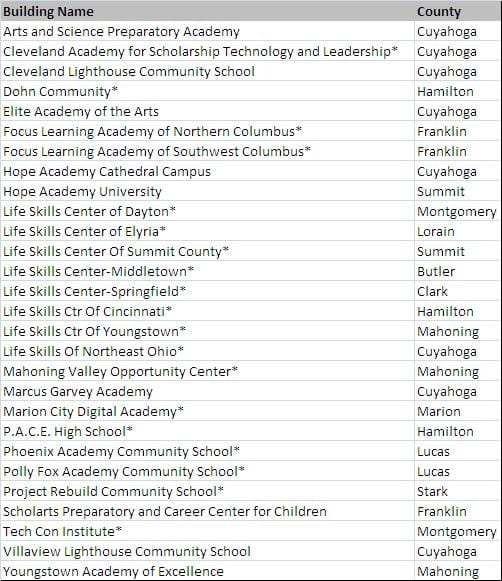
* denotes dropout recovery schools
Source: The Ohio Department of Education
As you can see in the chart above, the increase is largely due to the inclusion of dropout recovery schools. It’s also worth noting that while we expected to see more schools fall on the list under the governor’s proposal, it turns out that the A-F system might have saved one school (Lighthouse Community & Professional Development charter school) from automatic closure.
Stay tuned for more coverage of the Governor’s proposals in the weeks and months to come.
