
Guest blogger Layla Bonnot is a research intern at the Thomas B. Fordham Institute.
Is the number of free and reduced-price lunch participants an accurate proxy for the number of poor kids in America’s schools? New Jersey’s acting education commissioner, Chris Cerf, isn’t so sure. A recent article in The Star-Ledger highlights Cerf’s two concerns: first, that the self-reported basis of Free and Reduced Lunch Program (FRLP) participation makes the count prone to errors and—potentially—fraud, and second, that this number alone might not be a reliable proxy for the number of students living in poverty.
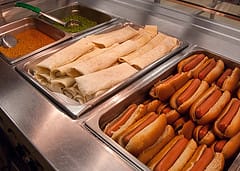 Mr. Cerf, I wouldn’t throw out school lunches quite yet—maybe just add a few other ingredients into the mix. Photo by U.S. Department of Agriculture. |
The issue of fraud in the lunch room pops up every couple of years. Detailed audits have shown that some students who should receive benefits do not, some parents or schools make honest mistakes on the application, and yes, there are some instances of fraud. Given our current situation of squeezed budgets and a National School Lunch Program that cost $9.7 billion in FY 10 and relies on self-reported income, those small instances of fraud can really add up (A 2009 2007 Mathematica study estimated the cost of errors close to $1 billion). It would be impractical, very time-consuming, and costly to audit every applicant in every district, but per USDA guidance, state chiefs can request that each district audit three percent of its participants whose incomes border the FRLP qualification level.
Requiring income verification from each participant would clamp down on fraud. This is already a requirement for SNAP recipients (whose children are auto-enrolled in the FRLP), but would increase the burden of the program for school districts—both in terms of time and money. Instead, the most promising solutions for improving accuracy seem to be quite simple: a streamlined application, additional training for those who process applications, clear consequences for fraud, and actual enforcement of those consequences. The optics of prosecuting parents for seeking help feeding their kids are as troubling as recent cases of mothers being arrested for “stealing” educational services, of course, and there is real danger that parents could be punished for an honest mistake such as not understanding the form or being bad at arithmetic.
The fraught nature of using FRLP participation as a measure of poverty is also a recurring issue in the news. David N. Bass’ piece in Education Next makes the point that using FRLP to drive education funding leads to over-reporting by schools to ensure additional funding from the district, state, and federal levels. The Shanker Institute’s Matt Di Carlo and others argue that the measure is too limiting, fails to shows degrees of poverty on either side of the qualification line, and should include other out-of-school factors.
In fact, while the Garden State’s funding system uses the FRLP count as its only measure of poverty, many other states either use it along with a combination of other factors or do not use it at all, relying instead on U.S. census data or enrollment in the Temporary Assistance for Needy Families (TANF) program. Using TANF or census data alone is problematic; TANF’s income requirement is much lower than FRLP and would identify a lower number of people in poverty than the free lunch program, while census bureau data is updated infrequently.
A compromise might be for New Jersey to look into a using a poverty formula (see the ‘Highly Impacted Schools Program’ in Utah) that gives weight to a number of factors, such as the number of ELL, special education, and FRLP participants, to give an overall measure of how much money should reach a given school for its entire student population. Respectfully, Mr. Cerf, I wouldn’t throw out school lunches quite yet—maybe just add a few other ingredients into the mix
