
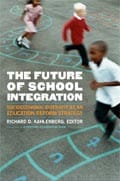
 The call for socioeconomically integrated schools is growing louder, and this volume, edited by the Century Foundation’s Richard Kahlenberg, explains why. He contends that socioeconomic integration is more than a politically palatable and legally permissible way to achieve racial integration: It is also an effective strategy for raising the academic achievement of both low-income and minority students—and one that could save districts dollars as it raises academic achievement without the need to pump copious extra funds into schools with concentrated poverty. That doesn’t mean it’s easy: In one chapter, Harvard doctoral candidate Marco Basile estimates that, in order to halve economic segregation, a quarter of all low-income students would need to transfer to affluent schools while a quarter of more-affluent students would need to enroll in schools located in more-disadvantaged neighborhoods. This swap, he estimates (using some questionable assumptions), would produce a per-student lifetime benefit of $33,010. But how to get affluent families to volunteer for such an experiment in “trading places”? Several authors argue for encouraging voluntary integration through the expansion of “controlled-choice” programs, and make astute suggestions for enhancing such efforts’ political feasibility. Unfortunately, though Kahlenberg’s thoughts on controlled choice have merit, he misses the mark when it comes to broader issues of choice. In the concluding chapter, he takes a swipe at the value of charter schools as an effective intervention for low-income students, questioning the scalability and cost-effectiveness of schools like KIPP that serve this population (predominantly in minority communities). What he needs to understand, though, is that “controlled choice” will be far more politically viable if it can coexist with, rather than compete with, charters and other forms of choice. Bottom line: For those who regard racial integration as an important education value, this book offers a strategy on how to bring it about legally. Unsurprisingly—considering the author roll—the book is stronger on the positives of this strategy than on the problems that accompany it.
Richard D. Kahlenberg, ed., The Future of School Integration: Socioeconomic Diversity as an Education Reform Strategy (Washington, D.C.: The Century Foundation, 2012).
