

After waiting years for the release of the very expensive, highly advanced Elementary/Secondary Information System (ElSi) database, education researchers from across the United States and around the world who met this week at the annual American Education Research Association (AERA) conference finally got a peek. And the more than 13,000 attendees, many of them highly regarded in the field, came to a shocking conclusion: the U.S. education system has been completely stagnant for the past two years. According to these comprehensive data, gathered by the National Center for Education Statistics (NCES) and used extensively by researchers all over the country, the entire public-education system has not enrolled a single student since June of 2011. In the previous decade, an average of nearly 50 million children were enrolled in public school (Figure 1). In contrast, ELSi does not report that even one student enrolled in either 2011–12 or 2012–13.
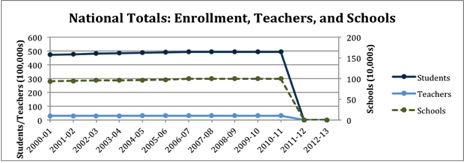
AERA president Wilhelm Tigernach stood by the shocking finding. “ELSi is the foremost database available to education researchers,” he explained. “It is maintained by the Institute of Education Sciences, a division of the U.S. Department of Education. There is no reason why ELSi data would not reflect the current state of public education.” When asked whether it was possible that the data were simply not yet available for the past two school years, Tigernach responded, “A two-year delay for basic information about our school system? At a time when market-research firms know what you had for lunch yesterday? That’s preposterous.” NCES did not respond to repeated requests for comment; reportedly its fax machines are down.
SOURCE: Big Brother, “Elementary/Secondary Information System” (Washington, D.C.: National Center for Education Statistics, April 2014).