In education, the quickest way to get approving head-nods from a crowd is to talk about the perils of rote and repetition. Students can’t learn “how to think,” after all, if they’re forced to memorize facts or repeat skills to automaticity. And teachers are not widgets merely implementing basic skills; they’re artists.
 |
Perhaps no applause line has done more damage to effective teaching than these attacks on repetition. This is something that Doug Lemov knows intimately, thanks in part to the thousands of hours he spent observing outstanding teachers in action. What he learned was that great teaching is born not of spontaneous and unpracticed excellence, but rather of spending more time than seems to make sense mastering seemingly mundane but crucially important knowledge and skills. In his first book, Teach Like a Champion, Lemov described 49 of the fundamental techniques that great teachers incorporated into their daily practice.
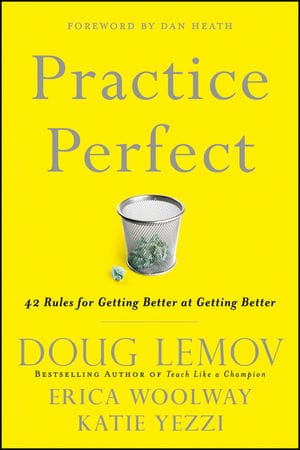
Lemov builds upon these insights in his latest book, Practice Perfect (coauthored with Erica Woolway and Katie Yezzi). The book is, at its core, a damning critique of the multi-billion dollar teacher professional development industry, which focuses almost no time and attention on actually helping teachers focus on and hone the skills they need to be effective. Teachers, Lemov suggests, are being served up the equivalent of art appreciation courses and then asked to paint a masterpieces. They are eager to learn new skills but “the plain fact is that we don’t help them to do so.”
Describing their own failure to help teachers translate techniques they learned in Teach Like a Champion into classroom practice, the authors explain:
we would show teachers one short video clip after another of superstar colleagues demonstrating a particular technique. We would analyze and discuss, and then, once our audience understood the technique in all of its nuance and variation, we went on to the next technique. Evaluations were outstanding…But then we noticed something alarming. If we surveyed the same participants three months later, they were not quite as upbeat. They still knew what they wanted their classes to be like, but they were unable to reliably do what it took to get there.
The problem was that the workshop participants, upon returning to their classrooms, “were trying to do the equivalent of walking onto center court at Wimbledon and learning a new style of backhand in the midst of a match.” And so Lemov and his colleagues changed the focus of their workshops. They taught fewer skills and they worked to create the space for practice. In short: They tried to do for teacher professional development what legendary coaches like John Wooden did for professional athletes—to focus on repetition, feedback, and practice aimed at helping teachers master a selective number of fundamental skills and techniques to automaticity.
Drawing on their own experience working to create a culture of practice in their workshops and schools, Practice Perfect offers 42 “rules” designed to help people “get better at getting better.” While ostensibly written for anyone, the book draws heavily on the authors’ experience as teachers and school leaders, as well as their experience trying to help educators improve their craft.
Teachers are rarely given the time and space to practice.
And that is where Practice Perfect has the potential to make the biggest impact. After all, other professions—sports, medicine, and on—understand the importance of practice and incorporate it into their training and development. But unlike doctors, who spend the first several years of their professional career focused on practice, or athletes who never stop practicing until retirement, teachers are asked to execute and perform, and, as they authors note, they “listen, reflect, discuss, and debate,” but they are rarely given the time and space to practice.
Like the techniques described in Teach Like a Champion, these “rules” are as simple, practical, and grounded in common sense and a respect for the practice and repetition we need to help teachers achieve mastery.
Of course, there will no doubt be plenty of skeptics—teachers among them—who worry that asking teachers to “practice” basic skills outside the context of a classroom will be contrived and ineffective. (Done poorly, it undoubtedly will be.) But those are the same people who would have scoffed at John Wooden for making his players practice—time and again—how to put on socks in just the right way, or for making them shoot without a ball to ingrain the proper form into muscle memory. Let’s hope that more use this as an opportunity to rethink the role of practice in teacher development and the importance of repetition to the artistry of teaching.